How to Tell If a Vacuum Bottle Lost Its Seal: Signs, Mistakes, and Lifespan Explained
A vacuum bottle can look perfectly normal on the outside and still stop performing the way it used to. That is why people often feel confused when a bottle that once kept coffee hot for hours suddenly cools too fast, or when ice water warms much sooner than expected. In many cases, the problem is not the drink, the room temperature, or even the lid. The real issue is that the bottle may have lost its vacuum seal.
This is one of the most common misunderstandings with insulated bottles. Users often assume that if a bottle is not leaking, then the seal must still be fine. But a vacuum bottle has two very different “seals” people talk about:
- the lid or gasket seal, which affects leakage
- the vacuum insulation seal, which affects temperature retention
When the vacuum structure is compromised, the bottle can still look fine, still close normally, and still hold liquid without leaking. But its insulation performance can drop sharply.
In this guide, we will explain how to tell if a vacuum bottle lost its seal, how to spot a broken Hydro Flask seal, what common vacuum sealing mistakes people make, how to open a container that is suctioned closed, and how long vacuum bottles usually last.
What does it mean when a vacuum bottle loses its seal?
A vacuum bottle works because it has two walls with a vacuum layer between them. That vacuum layer reduces heat transfer, which is why the bottle can keep hot drinks hot and cold drinks cold much longer than a single-wall container.
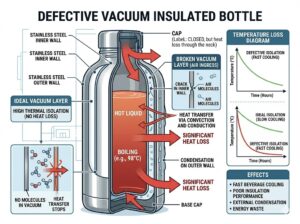
When people say a bottle “lost its seal,” they often mean the vacuum insulation structure is no longer intact. This does нет usually mean the drinking cap is loose. It means the insulated chamber between the walls has been compromised, so heat can move much more easily between the liquid inside and the outside environment.
This distinction matters because lid problems and vacuum-seal problems are not the same thing.
А lid seal problem usually causes:
- leaking
- poor closure
- dripping while drinking
- gasket issues
А vacuum seal problem usually causes:
- poor temperature retention
- warm or cold transfer to the outer wall
- sweating or condensation
- a bottle that behaves more like a standard single-wall container
So when trying to diagnose a bottle, the first step is to separate insulation failure from closure failure.
How to tell if a vacuum bottle lost its seal
The most obvious sign is a sudden and noticeable drop in insulation performance.
It no longer holds temperature the way it used to
If your vacuum bottle used to keep coffee hot most of the morning or keep ice water cold all day, and now it loses temperature much faster, that is the biggest warning sign.
A small difference in performance can happen because of:
- opening the bottle more often
- changing room temperature
- filling it with less liquid
- not preheating or prechilling it
But if the change is sharp and clearly worse than before, the vacuum seal may have failed.
The outer wall feels warm or cold
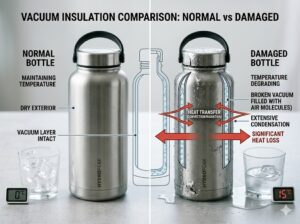
A working vacuum bottle should keep most of the temperature effect inside. If you pour in a hot drink and the outer wall starts feeling warm, or if you fill it with iced water and the outside feels unusually cold, that is a major clue that the insulation barrier is no longer doing its job.
This is one of the clearest practical signs because the outer wall of a healthy insulated bottle should not strongly reflect the drink temperature inside.
Condensation appears on the outside
With a proper vacuum-insulated bottle, outside sweating is usually minimal compared with a regular single-wall bottle. If your insulated bottle suddenly starts developing condensation or “sweating” on the outside, especially with cold drinks, that may suggest the insulation has been compromised.
This is not always absolute proof by itself, but combined with weak temperature retention, it is a strong indicator.
One part of the bottle feels different
Sometimes the whole bottle does not change evenly. Instead, one area of the bottle may feel warmer, colder, or more reactive than the rest. This can happen if the vacuum structure was damaged in a localized area.
If one spot becomes noticeably warm with hot liquid while the rest of the bottle stays normal, that is a sign something may be wrong internally.
Performance dropped after a dent or impact
Many vacuum bottles fail after being dropped, even if the damage looks minor. A dented base, a hard fall onto concrete, or a visible body deformation can affect the internal vacuum structure even if the bottle still looks usable.
This is one of the most common real-world causes of vacuum seal failure.
So if your bottle stopped insulating well shortly after a drop, that is not a coincidence you should ignore.
How to tell if a Hydro Flask seal is broken
This question comes up often because users search for “seal broken” when they may mean two completely different things.
A broken Hydro Flask vacuum seal
If the vacuum insulation seal is broken, the signs usually include:
- drinks no longer stay hot or cold as long
- the outside wall feels warm or cold during use
- the bottle starts sweating with cold drinks
- performance worsened after a dent or fall
This kind of failure affects temperature retention, not just leakage.
A broken Hydro Flask lid seal or gasket
If the lid seal is the issue, you may notice:
- water leaking when the bottle is tilted
- the cap not tightening properly
- sipping or closure problems even though temperature retention still seems normal
This kind of issue affects how the bottle closes and carries, but not necessarily how it insulates.
Why this distinction matters
A lot of users think a bottle is “broken” when the actual problem is only the lid or gasket. Others assume the cap is fine because the bottle does not leak, even though the vacuum chamber has already failed.
So if you are trying to tell whether a Hydro Flask seal is broken, first ask:
- Is it leaking?
- Or is it simply no longer insulating properly?
That answer helps you determine which “seal” is actually the problem.
What are common vacuum sealing mistakes?
A vacuum bottle usually does not fail randomly. In many cases, user handling plays a major role.
Dropping the bottle
This is the biggest and most common cause. The bottle may survive the fall structurally, but the internal vacuum chamber may no longer remain intact.
Even a small dent can matter more than people expect.
Using the bottle in ways it was not designed for
Misuse can shorten the life of a vacuum bottle. Examples include:
- putting it in extreme heat
- exposing it to direct flame or stove heat
- freezing it when the product is not designed for freezing
- forcing parts under unusual pressure
- improper dishwasher use if the model is not dishwasher-safe
Forcing lids or parts too aggressively
Cross-threading the cap, twisting too hard when parts are stuck, or repeatedly forcing a damaged closure can create problems that affect long-term performance or user perception.
This may not directly break the vacuum chamber every time, but it often leads to confusion between closure issues and insulation issues.
Ignoring dents and early warning signs
A lot of people keep using a dented bottle without checking whether insulation performance has changed. By the time they realize there is a problem, they no longer remember when it started.
Confusing lid problems with vacuum failure
This is one of the most common mistakes in diagnosis. A poor gasket, faulty straw lid, or worn closure may make a bottle feel “bad,” but that does not always mean the vacuum seal is gone.
Good troubleshooting starts with identifying whether the issue is:
- insulation
- leakage
- lid function
- or all three
How do you open a container that is suctioned closed?
This is a different issue from a broken vacuum bottle seal, but people often mix them together.
A container that is suctioned closed is usually dealing with pressure difference, not failed insulation.
This can happen when:
- warm contents cool down after sealing
- pressure drops inside the container
- the lid gets pulled tighter by the pressure change
Safe ways to open it
If a container is suctioned closed, try:
- running warm water around the lid area
- gently twisting instead of forcing
- loosening pressure gradually if the design allows
- tapping lightly around the closure area depending on the material
The goal is to reduce the pressure difference or improve grip, not to attack the container with force.
What not to do
Do not:
- use dangerous sharp tools
- force the threads aggressively
- deform the lid with brute force
- assume the bottle itself has lost its vacuum insulation seal
A suctioned lid is usually a temporary pressure problem.
A failed vacuum bottle seal is an insulation problem.
They are not the same thing.
How long do vacuum bottles last?
There is no single fixed lifespan that applies to every vacuum bottle. A good-quality vacuum bottle can last for many years if the structure remains intact and the bottle is used properly.
What determines lifespan?
The real lifespan depends more on condition than age. Key factors include:
- how often it is dropped
- whether it is dented
- how it is cleaned
- how it is stored
- whether the lid and gasket are maintained
- whether it is used within its intended purpose
What usually shortens the life of a vacuum bottle?
The most common causes are:
- impact damage
- repeated rough handling
- misuse under extreme heat or pressure
- worn closure parts
- corrosion or internal damage in neglected bottles
What users can realistically expect
A quality vacuum bottle can often remain usable for years. In many cases, the body lasts longer than the lid parts. What fails first is often:
- the gasket
- the cap mechanism
- the straw or closure parts
- or the vacuum structure after an impact
So the most realistic answer is:
A vacuum bottle can last a long time, but it usually stops performing because of damage or misuse, not simply because it became old.
How to protect a vacuum bottle from losing its seal
If you want your bottle to last longer, prevention matters much more than repair.
Avoid hard drops
A single impact can ruin the vacuum chamber even if the bottle still looks usable.
Clean it properly
Keep the bottle, lid, and gasket clean so you can tell the difference between odor, leakage, and insulation problems.
Use the correct lid and parts
A damaged or incompatible lid can create confusion and make the bottle seem worse than it really is.
Do not misuse it
Avoid exposing the bottle to conditions it was not designed for, especially extreme heat, pressure, or rough mechanical handling.
Check for changes early
If the bottle starts losing temperature faster, feels different on the outside, or develops condensation unexpectedly, inspect it before the issue gets worse.
Final answer: How to tell if a vacuum bottle lost its seal
The clearest sign that a vacuum bottle lost its seal is that it suddenly stops insulating the way it used to.
If your bottle:
- no longer keeps drinks hot or cold for normal periods
- feels warm or cold on the outside
- develops condensation unexpectedly
- changed performance after being dropped
then the vacuum insulation may be compromised.
If the problem is only leaking, dripping, or closure trouble, the issue may be the lid or gasket instead.
A suctioned lid is usually a separate pressure issue, not proof of vacuum failure. And a good vacuum bottle can last for years if the internal structure stays intact.
The best way to think about it is simple:
If the bottle starts acting more like a regular single-wall container than an insulated bottle, the vacuum seal may be gone.
FAQ
Can a vacuum bottle be repaired after losing its seal?
Usually not in a practical consumer sense. Once the internal vacuum insulation is compromised, replacement is often more realistic than repair.
Does a dent always mean the vacuum seal is broken?
No. But a dent is a warning sign, especially if insulation performance changes afterward.
Why is my insulated bottle sweating on the outside?
Unexpected condensation can suggest the insulation is no longer working properly, especially if the bottle also stops holding temperature well.
How do I know if my Hydro Flask is broken or just the lid?
If it leaks but still insulates normally, the lid or gasket may be the issue. If it no longer holds temperature and the outer wall reacts strongly to the drink temperature, the vacuum seal may be compromised.
How long should a vacuum insulated bottle last?
A good vacuum bottle can last for years, but drops, dents, misuse, and worn parts often shorten its effective life.
Is a suctioned lid the same as a failed vacuum seal?
No. A suctioned lid is usually a temporary pressure issue. A failed vacuum seal is an insulation failure inside the bottle wall structure.