
Can Yeti Cups Go in the Microwave? Understanding Microwave Safety for Stainless Steel Drinkware
Yeti cups, tumblers, and insulated mugs are among the most recognizable pieces of modern drinkware. Designed for durability and temperature retention, these products are commonly used for coffee, tea, iced beverages, and outdoor hydration. Their vacuum-insulated stainless steel construction allows drinks to remain hot or cold for extended periods, making them popular for commuters, travelers, and outdoor enthusiasts.
However, many users eventually face a practical question:
- Can Yeti cups go in the microwave?
- Can I microwave a stainless steel cup?
- Are insulated tumblers microwave safe?
- How do I know if a cup can safely be microwaved?
The short answer is no—most Yeti cups should non be placed in a microwave. Because they are made primarily from stainless steel and feature double-wall vacuum insulation, they are not compatible with microwave heating.
Understanding the materials used in insulated drinkware and the way microwave ovens interact with metal can help explain why these cups should not be microwaved and how to safely heat beverages for use in insulated containers.
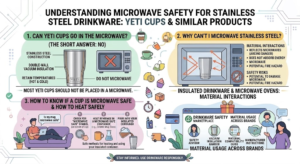
Key Takeaways
- Most Yeti cups are made from stainless steel and should not be microwaved.
- Metal reflects microwave energy and may cause sparks or appliance damage.
- Ceramic and glass cups are typically microwave safe.
- Insulated tumblers are designed to retain heat, not generate heat in a microwave.
- The safest method is to heat beverages separately and then pour them into the insulated cup.
What Are Yeti Cups Made Of?
Most Yeti drinkware products are constructed from 18/8 stainless steel, a high-grade alloy commonly used in food-grade containers and professional kitchen equipment. This material offers several advantages:
- high corrosion resistance
- durability under temperature changes
- resistance to odors and staining
- long-term structural stability
In addition to stainless steel, Yeti cups feature double-wall vacuum insulation. This design consists of two layers of stainless steel separated by a vacuum-sealed gap.
The vacuum layer minimizes heat transfer through conduction and convection, which helps beverages maintain their temperature for hours.
Typical structural components of a Yeti tumbler include:
| Component | Function |
| Stainless steel inner wall | Holds the beverage |
| Vacuum insulation chamber | Reduces heat transfer |
| Stainless steel outer wall | Provides durability |
| Plastic lid with sealing gasket | Prevents spills and heat loss |
This construction is ideal for maintaining temperature but makes the cup unsuitable for microwave heating.
How Microwave Ovens Heat Liquids
To understand why Yeti cups cannot go in the microwave, it helps to understand how microwave ovens work.
Microwave ovens heat food and liquids using electromagnetic radiation, typically at a frequency of 2.45 GHz. These waves excite polar molecules, especially water molecules, causing them to vibrate rapidly. This vibration generates heat throughout the liquid or food.
However, microwave energy interacts differently with different materials.
- Water-containing substances absorb microwave energy and heat up.
- Glass and ceramics allow microwaves to pass through with minimal interference.
- Metals reflect microwave energy instead of absorbing it.
Because stainless steel is a metal, it reflects microwave radiation rather than allowing the energy to penetrate the container.

Can You Microwave a Stainless Steel Cup?
Stainless steel drinkware should generally never be microwaved.
When microwave radiation encounters metal surfaces, several problems can occur:
- Reflection of microwave energy Metal reflects electromagnetic waves rather than allowing them to penetrate the container.
- Electrical arcing Reflected waves can create sparks or arcs inside the microwave.
- Uneven heating The liquid inside the metal container may not heat evenly or at all.
- Potential damage to the microwave Repeated reflection of microwave energy may stress the appliance’s internal components.
Although a single incident might not always cause immediate damage, microwaving metal containers increases the risk of appliance malfunction and safety hazards.
Why Yeti Cups Cannot Go in the Microwave
Most Yeti tumblers contain two characteristics that make them incompatible with microwave ovens:
- Stainless steel construction
- Vacuum-insulated double walls
The stainless steel body reflects microwave radiation, preventing proper heating of the liquid inside. Meanwhile, the insulated double-wall structure further blocks microwave penetration.
Even if the lid is removed, the metal body of the tumbler still prevents microwave heating.
Additionally, the sealed vacuum layer is designed for temperature retention, not for exposure to microwave energy. Heating the cup directly may stress the insulation structure and compromise the container over time.
What Happens If You Put a Yeti Cup in the Microwave?
Placing a stainless steel tumbler in the microwave may produce several outcomes depending on the appliance design and heating conditions.
Possible effects include:
- sparks inside the microwave chamber
- loud popping sounds
- minimal heating of the beverage
- overheating of specific areas of the microwave
In some cases, nothing dramatic may happen immediately, but this does not mean the practice is safe.
Microwaving metal containers repeatedly can eventually lead to:
- microwave magnetron stress
- interior surface damage
- electrical arcing
For this reason, microwave manufacturers typically advise against placing metal containers inside the appliance.

Can You Microwave a Ceramic-Lined Yeti Mug?
Some drinkware products feature ceramic interiors or ceramic-coated surfaces, which can create confusion about microwave safety.
Ceramic materials themselves are generally microwave safe because they allow microwave energy to pass through and heat the liquid inside.
However, not all ceramic-lined drinkware is suitable for microwaving. Some insulated mugs contain hidden metal layers beneath the ceramic coating, especially in insulated designs.
Before microwaving a ceramic-lined mug, it is important to verify:
- manufacturer guidelines
- microwave-safe labeling
- absence of metal components
If the mug contains a stainless steel shell or vacuum insulation layer, it should not be microwaved even if the interior is ceramic-coated.
Why Are Some Yeti Mugs Recalled?
From time to time, manufacturers may issue recalls related to certain product models or manufacturing batches.
Product recalls typically occur due to:
- lid seal defects
- safety concerns related to pressure or leakage
- manufacturing inconsistencies
These recalls are usually limited to specific models rather than all products from a brand.
If a recall occurs, manufacturers provide detailed information about affected products and offer replacement or refund options. Consumers can verify recall status through official company announcements or product registration systems.
How to Tell If a Cup Is Microwave Safe
Before placing any container in a microwave, it is important to verify whether the material is compatible with microwave heating.
Check for Microwave-Safe Labels
Many containers include symbols indicating microwave safety. These may appear on the bottom of the container or in product documentation.
Common indicators include:
- “Microwave Safe” label
- microwave-safe icon
- manufacturer usage instructions
If the container lacks such labeling, it is best to assume it may not be microwave safe.
Identify the Material
The material used in the cup often determines whether it can be safely microwaved.
| Materiale | Microwave Safe | Reason |
| Stainless steel | NO | Reflects microwave radiation |
| Glass | SÌ | Allows microwaves to pass through |
| Ceramic | Usually yes | Absorbs little microwave energy |
| Microwave-safe plastic | SÌ | Designed for microwave heating |
Because Yeti cups are stainless steel, they fall into the non-microwave-safe category.

Avoid Containers With Metal Components
Even containers that appear ceramic or glass may contain metal accents, including:
- metallic rims
- decorative plating
- hidden structural metal layers
These metal components can cause sparks in a microwave and should be avoided.
Microwave-Safe vs Insulated Drinkware
The key difference between microwave-safe containers and insulated drinkware lies in their design purpose.
| Drinkware Type | Microwave Safe | Mantenimento della temperatura |
| Stainless steel tumbler | NO | Excellent |
| Double-wall insulated mug | NO | Excellent |
| Ceramic mug | SÌ | Moderare |
| Glass cup | SÌ | Moderare |
Insulated drinkware is designed to retain heat, not to generate heat through microwaving.
Safe Ways to Heat Drinks Before Using a Yeti Cup
Even though Yeti cups cannot go in the microwave, they can still be used effectively for hot beverages.
The safest method is to heat the liquid separately and then pour it into the insulated container.
Recommended methods include:
- heating water in an electric kettle
- microwaving coffee in a ceramic mug
- heating liquids on the stovetop
- using hot water from a coffee machine
Once the beverage is poured into the Yeti cup, the vacuum insulation will maintain its temperature for extended periods.
Final Verdict
Most Yeti cups are constructed from stainless steel and feature double-wall vacuum insulation. Because stainless steel reflects microwave radiation and insulated structures prevent proper energy absorption, these cups should not be placed in microwave ovens.
Microwaving metal containers can lead to sparks, uneven heating, and potential damage to the appliance. Instead, beverages should be heated in microwave-safe containers such as ceramic or glass before being transferred into a Yeti tumbler.
Using your insulated drinkware this way allows you to enjoy the benefits of temperature retention while avoiding microwave safety risks.
FAQ
Can I microwave a stainless steel cup? No. Stainless steel reflects microwave radiation and can cause sparks or uneven heating.
Can you microwave a ceramic-lined Yeti mug? Only if the manufacturer confirms it is microwave safe and the mug contains no metal layers.
Why does metal spark in a microwave? Microwave radiation reflects off metal surfaces, which can create electrical arcs or sparks inside the appliance.
How should I heat coffee for a Yeti cup? Heat the coffee in a microwave-safe container or kettle first, then pour it into the Yeti tumbler to maintain temperature.