What Is a Vacuum Flask? Definition, Structure, and How It Works
Perkenalan
Why does your coffee stay hot for hours in a vacuum flask—but cool down quickly in a regular cup?
The answer lies in how heat moves—and how a vacuum flask is designed to slow that process down.
A vacuum flask is one of the most practical thermal inventions used in everyday life. Whether you’re commuting, traveling, or working in an office, it helps maintain the temperature of liquids without any external energy.
But many people misunderstand how it actually works.
A vacuum flask does not “lock in heat”—it reduces heat transfer as much as possible.
In this guide, we’ll explain what a vacuum flask is, how it is structured, how it works, and why it performs so much better than ordinary containers.
What Is a Vacuum Flask?
Simple Definition
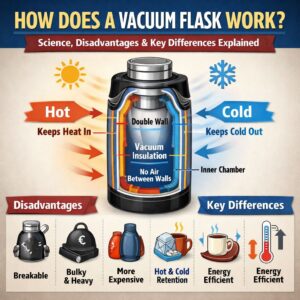
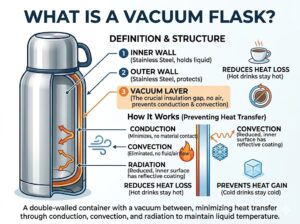
A vacuum flask is an insulated container designed to keep liquids hot or cold by using a double-wall structure with a vacuum layer between the walls.
Quick Answer
What is a vacuum flask? A vacuum flask is a container that uses a vacuum-insulated double wall to reduce heat transfer, allowing liquids to maintain their temperature for extended periods.
Common Materials
Modern vacuum flasks are typically made from:
- baja tahan karat 304 (standard food-grade material)
- 316 stainless steel (more resistant to corrosion, often used for premium products)
- Glass (used in traditional vacuum flasks but less durable)
These materials are chosen for their durability, safety, and thermal performance.
Main Components of a Vacuum Flask
Understanding the structure helps explain how the flask works.
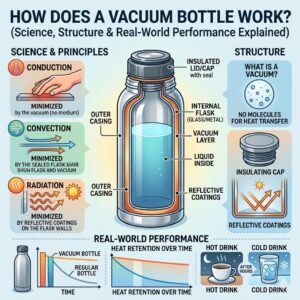
Inner and Outer Walls
- Itu inner wall holds the liquid
- Itu outer wall protects the structure
Both are usually made from stainless steel and separated by a gap.
Vacuum Layer (Core Component)
The space between the walls is vacuum-sealed, meaning most air is removed.
This vacuum layer is the key reason vacuum flasks work so effectively.
Lid and Seal System
The lid includes:
- A sealing ring (often silicone or rubber)
- A threaded or press-fit cap
This prevents heat from escaping through the opening.
Reflective Coating
Some vacuum flasks include a thin metallic coating on the inner surface.
This coating reflects heat energy and reduces thermal radiation loss.

How Does a Vacuum Flask Work?
To understand how a vacuum flask works, you need to understand how heat moves.
Heat Transfer Basics
Heat moves in three main ways:
- Conduction – through solid materials
- Convection – through air or liquid movement
- Radiation – through infrared energy
How the Vacuum Reduces Heat Loss
The vacuum layer works because it removes the medium needed for heat transfer:
- No air = no convection
- Almost no particles = minimal conduction
This leaves radiation as the only remaining heat transfer method.
Why It Keeps Drinks Hot or Cold
Because heat transfer is reduced:
- Hot liquids lose heat more slowly
- Cold liquids gain heat more slowly
This is why a vacuum flask can maintain temperature for hours.
Why the Lid Matters
Even with perfect insulation in the walls, heat can still escape through the opening.
In real usage:
The lid can be the weakest point in thermal insulation.
A poorly sealed lid can significantly reduce performance.
What Is a Vacuum Flask Used For?
Everyday Use
- Coffee and tea
- Water
- Soup and hot beverages Travel and Outdoor Use
- Hiking and camping
- Road trips
- Long commutes
Commercial and Industrial Use
- Beverage transport
- Promotional or branded products
Vacuum Flask vs Regular Bottle
Key Differences
| Fitur | Vacuum Flask | Regular Bottle |
| Isolasi | Tinggi | Low |
| Temperature retention | Long | Short |
| Structure | Double-wall | Single-wall |
| Heat transfer | Reduced | Direct |
| Biaya | Higher | Lower |
Vacuum Flask vs Thermos
Thermos Is a Brand
Thermos is a well-known manufacturer of insulated containers.
Vacuum Flask Is a Technology
- Vacuum flask = insulation method
- Thermos = brand name
Why People Confuse Them
This is similar to how:
- “Kleenex” is used for tissues
- “Google” is used for search
Over time, the brand name becomes the generic term.
Advantages of a Vacuum Flask
Retensi Suhu
- Keeps drinks hot or cold for hours
- Suitable for daily and outdoor use
Energy Efficiency
- No electricity required
- Passive insulation system
Convenience
- Portable
- Dapat digunakan kembali
- Suitable for multiple scenarios
Limitations of a Vacuum Flask
Not Perfect Insulation
Heat transfer is reduced—but not eliminated.
Over time, temperature will still change.
Can Be Damaged
If the vacuum seal is broken:
- Air enters the gap
- Insulation performance drops
Higher Cost
Vacuum flasks are more expensive than regular bottles, especially high-quality models.
Maintenance Required
- Seals can wear out
- Cleaning is necessary to prevent odor
How to Choose a Good Vacuum Flask
Choosing a vacuum flask is not just about brand or appearance. From a product engineering and manufacturing perspective, thermal performance, durability, and real usability depend on several critical factors.
Understanding these factors will help you avoid common mistakes—especially when comparing low-cost products with high-quality custom solutions.
Key Factors
1. Material: 304 vs 316 Stainless Steel
Material directly affects safety, durability, and corrosion resistance.
- baja tahan karat 304
- Standard food-grade material
- Suitable for daily use
- Cost-effective
- 316 stainless steel
- Higher resistance to corrosion and chemicals
- Better for acidic beverages (coffee, juice)
- Used in premium or long-term products
From an industry standpoint, most mid-to-high-end vacuum bottles use 304 internally, while premium custom products may upgrade to 316 for enhanced performance.
2. Insulation Performance (Not Just “Hours”)
Many brands claim “12 hours hot” or “24 hours cold,” but real performance depends on:
- Vacuum quality
- Wall thickness
- Lid sealing design
A well-manufactured vacuum flask reduces heat transfer through conduction and convection by using a near-vacuum layer , while reflective surfaces minimize radiation loss .
From practical testing:
Two bottles with the same “12-hour” claim can perform very differently depending on manufacturing quality.
3. Seal and Lid Design (Most Overlooked Factor)
The lid is often the weakest point in insulation systems.
Key features to look for:
- Silicone sealing ring
- Leak-proof threading or locking system
- Double-seal structure (premium designs)
Engineering insight:
Most heat loss in a vacuum flask occurs at the neck and lid area, where the vacuum barrier is interrupted .
This means even a high-quality body can underperform if the lid is poorly designed.
4. Capacity and Structure Design
Capacity is not just about volume—it affects usability.
- Small (300–500ml) → office, daily commute
- Sedang (500–750ml) → travel and general use
- Large (1L+) → outdoor or long trips
Also consider:
- Narrow vs wide mouth
- Grip design
- Weight and portability
Choosing by Use Case
Office and Daily Use
For office environments, the ideal vacuum flask should be:
- Lightweight and compact
- Easy to open and close
- Moderate insulation (6–10 hours is sufficient)
This type prioritizes convenience over maximum insulation performance.
 Travel and Commuting
For travel use, focus on:
- Leak-proof design
- Durable outer shell
- Balanced capacity
A poorly sealed bottle can cause leakage during movement, which is one of the most common user complaints.
Outdoor and Long-Term Use
For outdoor or extended use scenarios:
- Larger capacity
- Strong insulation performance
- Impact-resistant structure
These applications require more robust construction and higher vacuum stability.
Professional Insight: Why Custom Vacuum Bottles Perform Better
From a manufacturing perspective, custom vacuum bottles often outperform generic retail products because they allow control over:
- Material grade (304 vs 316)
- Vacuum sealing process
- Lid and sealing structure
- Surface finishing and branding
A good example is a custom solution like:
Botol Vakum Kustom
Compared to standard retail bottles, custom vacuum bottles are typically designed with:
- Optimized insulation structure for consistent performance
- Higher-quality sealing systems
- Branding flexibility for corporate or promotional use
This is especially important for:
- Hadiah perusahaan
- Promotional products
- B2B bulk purchasing
Practical Buying Tips (Highly Recommended)
Based on real-world usage and product evaluation:
- Do not rely only on “hours” claims—check build quality
- Always prioritize seal design over appearance
- Choose capacity based on real usage, not maximum size
- For long-term use, invest in better materials and structure
Key Takeaway
A good vacuum flask is not defined by brand alone—it is defined by engineering quality, sealing design, and how well it matches your real usage scenario.
Kesimpulan
A vacuum flask works by reducing heat transfer through a combination of:
- Vacuum insulation (eliminating conduction and convection)
- Reflective surfaces (reducing radiation)
- Sealed design (minimizing heat loss)
The most important thing to understand is:
A vacuum flask does not stop heat transfer—it slows it down significantly.
This is what allows it to keep drinks hot or cold far longer than ordinary containers.
Tanya Jawab Umum
What is inside a vacuum flask?
A vacuum flask contains two walls with a vacuum layer between them, along with a sealed lid and sometimes a reflective coating.
How long does a vacuum flask keep drinks hot?
Typically between 6–12 hours for hot liquids and up to 24 hours for cold liquids, depending on quality.
Is a vacuum flask better than a regular bottle?
Yes, for temperature retention, but it is more expensive.
Why does a vacuum flask stop working?
Usually due to vacuum seal failure or damaged lid seals.
Is Thermos the same as a vacuum flask?
No. Thermos is a brand, while a vacuum flask is the technology used for insulation.