Can Hydro Flask Lose Insulation? How Long It Lasts, Signs of Failure, and Free Replacement Explained
A Hydro Flask that used to keep drinks cold all day can feel disappointing when it suddenly seems to lose performance. That is why so many people search questions like “Can Hydro Flasks lose their insulation?” or “How long does Hydro Flask insulation last?” The short answer is yes: a Hydro Flask can lose insulating performance if its vacuum structure is compromised. Hydro Flask’s own support content says that if you feel “hot spots” during its insulation test, the insulation has been compromised and the flask is eligible for replacement.
The more important point is that this is not unique to Hydro Flask. Hydro Flask bottles are marketed as stainless steel bottles with TempShield double-wall vacuum insulation, and the 20 oz Wide Mouth page lists “24 hours cold, 12 hours hot” along with “leakproof when closed” and “pure taste, no flavor transfer.” That means the bottle’s performance depends on its insulated structure staying intact. When that structure fails, the bottle may still look usable, but it will not perform the same way.
Can Hydro Flasks lose their insulation?
Yes. Hydro Flask’s own warranty and support materials make that clear. The company’s insulation test guidance says that if you feel hot spots on the outside of the flask during the test, the insulation has been compromised. Its warranty materials also state that Hydro Flask will replace products found to be defective within the scope of normal and appropriate use.
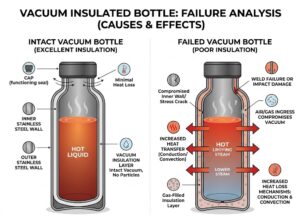
That does not mean Hydro Flask bottles are designed to “wear out” quickly. It means that, like other vacuum-insulated bottles, they rely on a sealed vacuum layer between two walls. If that sealed structure is damaged, insulating performance can drop sharply. In practice, users often notice that cold drinks warm up faster than before or hot drinks no longer stay hot for as long as expected. Hydro Flask’s official insulation claims only make sense while that insulated system remains intact.
Do water bottles lose insulation over time?
This depends on what kind of bottle you mean. A regular single-wall water bottle does not have vacuum insulation to lose in the first place. A vacuum-insulated bottle is different. Its thermal performance does not usually fade gradually like a battery. Instead, the bigger risk is structural or seal-related failure. If the vacuum layer stays intact, the insulation should remain effective for a long time. If the bottle is damaged or the vacuum seal is compromised, performance can change quickly.
Many people think their bottle “lost insulation over time” when the issue is actually something else. Sometimes the lid or gasket is the problem, not the bottle body. Hydro Flask has separate cap and lid warranty guidance, which itself shows that lids are a meaningful part of product performance. If a lid leaks, seals poorly, or no longer closes properly, the bottle may seem worse even if the insulated body is still fine.
That is why it helps to separate two problems: bottle-body insulation failure and lid-performance decline. The first is about the vacuum structure. The second is about how well the cap or gasket continues to seal in real use. Both affect the user experience, but they are not the same failure.
How long does Hydro Flask insulation last?
Hydro Flask does not market insulation as a short-life feature. Its product pages continue to present bottles as long-term reusable gear, and its warranty language is framed as a limited lifetime warranty for flasks and bottles against manufacturing defects under normal and appropriate use. That strongly suggests Hydro Flask expects the bottle body’s insulated structure to last for years, not months, when the product remains intact.
In real life, the answer is less about time alone and more about condition. A Hydro Flask used normally, without major impact damage or misuse, should retain insulating performance for a long time. What usually shortens effective life is not age by itself, but drops, dents, seal damage, misuse, or component wear. Hydro Flask’s own product page also says the bottle is not for use on a stove, in a microwave, or freezer, which shows that the company treats improper use as a meaningful risk to product performance and safety.
So the best answer is this: Hydro Flask insulation is meant to last for years, but it lasts only as long as the vacuum structure and sealing system remain sound. If the bottle has been dropped hard, develops hot spots, or suddenly stops retaining temperature the way it used to, that points more toward damage or defect than ordinary aging.
How to tell if a Hydro Flask has lost insulation
The clearest official sign is the “hot spot” test. Hydro Flask’s support guidance says that if, during the insulation test, you feel any hot spots on the outside of the flask, the insulation has been compromised and the bottle is eligible for replacement. That makes hot spots the most direct signal the company itself recognizes.
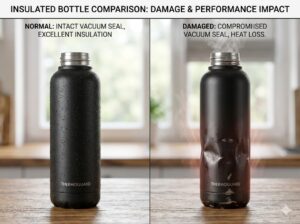
Users may also notice other practical signs before running that test. Cold drinks may stop staying cold nearly as long as before. Hot drinks may cool much faster. The bottle may feel unusually warm on the outside when filled with hot liquid. These are all consistent with the idea that the vacuum-insulated structure is no longer performing normally. Hydro Flask’s support content centers the hot-spot issue because it is one of the easiest ways for consumers to detect possible insulation failure without cutting the bottle open or performing formal thermal testing.
It is equally important to know what does not automatically mean insulation failure. Surface scratches, scuffs, or cosmetic wear do not prove the insulation is gone. Even some dents may be mostly cosmetic. But if a noticeable dent is followed by a sudden drop in temperature retention, that combination is much more concerning than appearance alone. Hydro Flask’s warranty language also distinguishes manufacturing defects from normal wear and tear, which is another reason to be careful about assuming every visible mark equals a warranty-eligible failure.
What usually causes Hydro Flask insulation failure?
One common cause is impact damage. A bottle can look mostly fine after a hard drop but still suffer internal vacuum damage. Since vacuum insulation depends on a sealed structure, a heavy impact can compromise performance even if there is no dramatic visible crack. This is one reason many users describe a bottle as “suddenly not working like before” after a drop. Hydro Flask does not publicly say every dent voids performance, but its hot-spot replacement guidance shows that compromised insulation is a recognized failure mode.
Another cause can be a manufacturing defect. Hydro Flask’s limited lifetime warranty for flasks and bottles is specifically about defects in normal and appropriate use, which implies that some failures may come from defects rather than consumer misuse. That is exactly why the replacement process exists.
Misuse also matters. Hydro Flask’s own 20 oz Wide Mouth page says the bottle is not for use on a stove, in a microwave, or freezer. Using the product outside those limits may create problems that look like insulation failure but are really the result of handling the bottle in a way the product was not designed for.
Can I replace my Hydro Flask for free?
Sometimes, yes. Hydro Flask’s support pages say the company does not require proof of purchase or a fee for its lifetime warranty program for flasks and bottles, and that photos are required for warranty requests. The company also says it will replace products found to be defective within the scope of normal and appropriate use. That means a free replacement is possible, but it is not unconditional. The bottle still has to qualify under the warranty guidelines.
Hydro Flask’s general warranty materials also make clear what is not covered. The limited warranty covers manufacturing defects, but it does not include just any damage or defect. That distinction matters. Cosmetic wear, scratches, or ordinary signs of use are not the same as a qualifying defect. The same general logic applies to caps and lids: Hydro Flask has a separate cap/lid warranty process, and photos may be required there too.
So if your Hydro Flask has truly lost insulation and shows the kind of issue Hydro Flask recognizes, such as hot spots during the official insulation check, a free replacement may be available through the warranty process. If the issue is only cosmetic or falls outside normal and appropriate use, the answer may be different.
What to do if your Hydro Flask stops keeping drinks cold or hot
Start by checking whether the problem seems to come from the bottle body or the lid. If the cap no longer seals properly, leaks, or feels loose, look at the cap/lid warranty guidance first. If the bottle body itself seems wrong, run Hydro Flask’s insulation test and check for hot spots.
Next, compare today’s performance with how the bottle used to behave. If the change was sudden, especially after a drop, the vacuum structure may have been compromised. If the change is minor and mostly connected to leaking, sipping difficulty, or closure problems, the lid may be the bigger issue.
If you suspect a warranty-eligible problem, use Hydro Flask’s warranty process and prepare the required photos. Hydro Flask’s support results say photos are required for all warranty requests, and the process page says the customer care team reviews the submitted images. Since Hydro Flask does not require proof of purchase for this program, the photo documentation becomes especially important.
Final answer
Yes, Hydro Flasks can lose insulation. Hydro Flask’s own support content says that if you feel hot spots, the insulation has been compromised, which is the clearest official confirmation that insulation failure can happen.
No, that does not mean Hydro Flask insulation is supposed to fade naturally after a short period. Under normal and appropriate use, Hydro Flask presents its bottles as long-term vacuum-insulated products backed by a limited lifetime warranty against manufacturing defects.
As for replacement, you may be able to get a Hydro Flask replaced for free if the issue qualifies under Hydro Flask’s warranty program. The company says proof of purchase is not required for the flask and bottle lifetime warranty program, but photos are required and claims are reviewed.
The practical takeaway is simple: a Hydro Flask does not usually “go bad” just because it is old. The real question is whether its vacuum structure is still intact. If the bottle suddenly stops performing, develops hot spots, or seems dramatically worse after impact, that is when insulation failure becomes a real possibility.
FAQ
Can Hydro Flasks lose their insulation over time? They can lose insulating performance if the vacuum structure is compromised, but Hydro Flask does not present this as normal age-related fade.
Do water bottles lose insulation over time? Vacuum-insulated bottles do not usually “wear out” thermally on their own, but they can seem to lose insulation when the body, seal, or lid system is damaged.
How long does Hydro Flask insulation last? Hydro Flask does not give a fixed number of years. Its bottle pages and limited lifetime warranty positioning suggest the insulation should last for years under normal and appropriate use.
Can I replace my Hydro Flask for free? Possibly. Hydro Flask says proof of purchase is not required for flask and bottle warranty claims, but photos are required and only qualifying defects are covered.
How do I know if my Hydro Flask lost insulation? Hydro Flask says that if you feel hot spots during its insulation test, the insulation has been compromised