Can We Store Breast Milk in a Steel Bottle? Safety, Hygiene, and Storage Guidelines Explained
When pumping breast milk at work, traveling, or commuting, many parents look for practical storage solutions. Stainless steel bottles and insulated tumblers are durable, reusable, and temperature-retaining—so it’s natural to ask:
- Can I put breast milk in a stainless steel bottle?
- Is stainless steel safe for breast milk?
- Can I store breast milk in a steel container for a long time?
- Can I put breast milk in a Stanley?
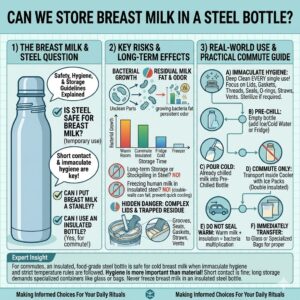
The short answer is: Yes, food-grade stainless steel can safely hold breast milk for short-term storage, provided hygiene and temperature guidelines are strictly followed. However, stainless steel containers are not always the ideal choice for long-term storage or freezing.
The most important factors in breast milk safety are not just material—but cleanliness, temperature control, and storage duration.
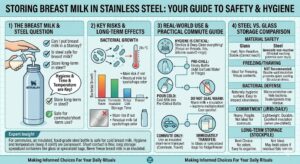
Key Takeaways
- Food-grade stainless steel is generally safe for short-term milk storage.
- Temperature control is more important than container material.
- Insulated tumblers are not designed specifically for breast milk.
- Long-term storage is better in purpose-built containers.
- Always follow pediatric storage guidelines.
Is Stainless Steel Safe for Breast Milk?
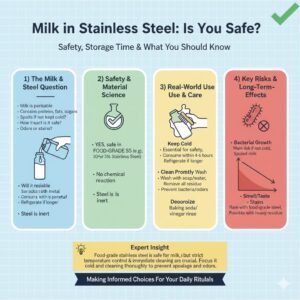
High-quality stainless steel—especially 304 (18/8) or 316 stainless steel—is widely considered safe for food and beverage contact.
Why Food-Grade Stainless Steel Is Considered Safe
Food-grade stainless steel:
- Is corrosion-resistant
- Does not contain BPA
- Has a non-reactive surface when intact
- Is commonly used in food processing and medical equipment
The chromium content in stainless steel forms a protective layer (chromium oxide) that reduces interaction between the metal and liquids. Breast milk, while biologically complex, is not strongly acidic, so it does not typically react with stainless steel under normal conditions.
In terms of material safety alone, stainless steel is considered safe for contact with breast milk.
Can I Put Breast Milk in a Stainless Steel Bottle?
The short answer is: Yes, you can place breast milk in a food-grade stainless steel bottle — but only under appropriate conditions.
The safety of storing breast milk in stainless steel depends on three critical factors:
- The grade and condition of steel
- Hygiene and sterilization practices
- Temperature control and storage duration
Stainless steel itself is not inherently unsafe. In fact, high-quality stainless steel (such as 304 or 316 grade) is widely used in food processing, dairy equipment, and medical environments because of its corrosion resistance and cleanability.
However, breast milk is not an ordinary beverage. It is a biologically active fluid containing fats, proteins, immune cells, and enzymes. That means storage standards are much stricter than for water or coffee.
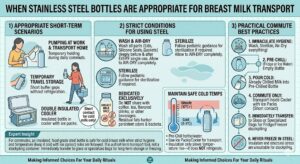
When Is It Appropriate to Use a Stainless Steel Bottle?
1. Short-Term Transport After Pumping
A stainless steel bottle can be appropriate when:
- You are pumping at work and transporting milk home
- You need temporary storage during travel
- You hold milk in a cooler with ice packs for several hours
In these scenarios, stainless steel can function as a temporary holding container, especially if it is insulated and helps maintain low temperatures.
However, the container must meet strict conditions:
- It must be thoroughly washed and air-dried before use
- It should be sterilized according to pediatric guidance if required
- It must be dedicated exclusively to breast milk (not shared with coffee, tea, or flavored drinks)
- It must maintain safe cold temperatures
Insulated stainless steel bottles can slow temperature rise, but they do not replace refrigeration. Ice packs or a cooler are still required for safe transport.
2. Is Stainless Steel Safe for the Milk Itself?
From a material perspective:
Food-grade stainless steel is:
- Non-porous
- Resistant to corrosion
- Stable under cold storage conditions
Breast milk is not highly acidic, so it does not aggressively react with intact stainless steel surfaces.
The greater concern is not chemical reaction, but microbial contamination.
If a bottle is scratched, dented internally, or has areas that trap residue, bacterial growth becomes a bigger risk than any metal interaction.
Can I Store Breast Milk in a Steel Container Long-Term?
For extended storage — especially refrigeration beyond a day or freezing — stainless steel bottles are generally not the preferred option.
While the steel itself may be safe, practical and hygiene concerns make specialized breast milk containers superior.
Why Stainless Steel Is Not Ideal for Long-Term Storage
1. Measurement and Portion Control
Most stainless steel bottles:
- Do not have accurate volume markings
- Make it harder to portion milk
- Increase the likelihood of thawing more milk than needed
Breast milk storage is often done in small, measured quantities to avoid waste.
2. Lid and Seal Design
General stainless steel tumblers (including travel mugs and insulated cups):
- Often have complex lids
- Include silicone gaskets or sliding components
- Contain small crevices
Milk fat can cling to these areas. Even with washing, microscopic residue may remain if not disassembled and cleaned thoroughly.
Milk residue is an ideal environment for bacterial growth.
3. Freezing Considerations
Breast milk expands when frozen.
Stainless steel bottles are:
- Rigid
- Not designed for freezer expansion margins
- Often cylindrical and inefficient for stacking
Breast milk storage bags and dedicated plastic or glass containers are:
- Designed to allow expansion
- Stackable
- Easier to label with dates
- Space-efficient
4. Long-Term Hygiene Monitoring
Breast milk storage requires strict tracking of:
- Pumping date
- Refrigeration time
- Freezer duration
- Thawing window
Standard steel bottles lack labeling surfaces and freezer optimization, making management less practical.
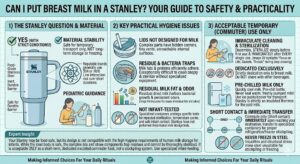
Can I Put Breast Milk in a Stanley?
Stanley insulated tumblers are designed primarily for beverages like water, coffee, and iced drinks.
While the stainless steel body may be food-safe, several practical issues apply:
- Lids are not designed specifically for milk storage
- Straw lids and flip mechanisms may retain residue
- They are not tested or marketed as breast milk storage containers
Using a Stanley for temporary transport only, with proper sterilization and cold control, may be acceptable.
However, it should not replace containers specifically designed for infant feeding and storage.
The Most Important Factor: Temperature Control
Material safety is only one part of breast milk storage.
The most critical factor is keeping milk within safe temperature ranges.
Breast milk safety depends on:
- Minimizing time at room temperature
- Prompt refrigeration
- Avoiding repeated warming and cooling cycles
- Maintaining cold chain integrity during transport
An insulated stainless steel bottle may slow warming — but it does not eliminate bacterial growth risk if left unrefrigerated too long.
Always follow official pediatric and public health guidelines for storage time and temperature limits.
Stainless Steel vs Glass vs Plastic for Breast Milk
| Feature | Stainless Steel | BPA-Free Plastic (Breast Milk Storage) | Glass |
| Chemical Stability | High | High (if certified) | Very High |
| Break Risk | Low | Low | Higher |
| Freezer Compatibility | Limited | Designed for freezing | Good |
| Measurement Markings | Rare | Yes | Yes |
| Stackability | Limited | Excellent | Moderate |
| Insulation | Often Yes | Usually No | No |
For long-term storage, purpose-built breast milk containers are typically superior in terms of usability and management.
Can I Put Breast Milk in a Stanley?
Stanley insulated tumblers are designed primarily for beverages like coffee and water.
While the stainless steel body itself may be food-safe, there are practical concerns:
- Lid mechanisms may contain crevices that are difficult to fully sanitize.
- Straw lids and flip caps can trap milk residue.
- These containers are not specifically engineered for breast milk storage.
If using an insulated tumbler temporarily, it should:
- Be thoroughly sterilized beforehand
- Be used only for milk (not previously for coffee or flavored drinks without deep cleaning)
- Maintain cold temperatures with ice packs
However, a dedicated breast milk storage bottle remains the safer and more controlled option.
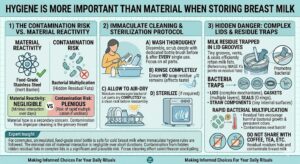
Hygiene Is More Important Than Material
When storing breast milk, contamination risk is more significant than material reactivity.
Cleaning and Sterilization
Before using any stainless steel container for breast milk:
- Wash thoroughly with warm, soapy water
- Rinse completely
- Allow to air dry
- Sterilize according to pediatric guidance if necessary
Special attention should be given to:
- Lids
- Gaskets
- Seals
- Straw components
Milk residue trapped in lid grooves can promote bacterial growth.
Temperature Control: The Critical Factor
Breast milk safety depends heavily on storage temperature.
General pediatric guidance typically emphasizes:
- Limiting room temperature exposure
- Prompt refrigeration
- Controlled freezer storage
- Avoiding repeated temperature fluctuations
An insulated stainless steel bottle may slow temperature change—but it is not a substitute for refrigeration.
If transporting milk:
- Use an insulated cooler with ice packs
- Transfer to refrigerator as soon as possible
Always follow official health authority guidelines for storage duration.
Stainless Steel vs Plastic vs Glass for Breast Milk
| Feature | Stainless Steel | BPA-Free Plastic | Glass |
| Chemical Stability | High | Depends on quality | Very High |
| Break Risk | Low | Low | Higher |
| Weight | Moderate | Light | Heavy |
| Freezer Practicality | Limited | Excellent | Good |
| Insulation | Often Yes | Usually No | No |
Plastic and glass containers designed specifically for breast milk are typically optimized for:
- Measurement accuracy
- Freezer expansion
- Secure sealing
- Ease of stacking
Stainless steel works best for temporary transport—not long-term storage systems.
When Should You Avoid Using a Steel Bottle for Breast Milk?
Do not use a stainless steel bottle if:
- The interior surface is scratched or pitted
- The steel grade is unknown
- The container previously held strongly flavored drinks and wasn’t deeply cleaned
- The lid design cannot be fully disassembled and sanitized
- You intend to freeze milk long-term
In these situations, purpose-built breast milk storage containers are preferable.
Does Stainless Steel Affect Breast Milk Nutrients?
There is no strong evidence suggesting that intact food-grade stainless steel significantly alters breast milk composition during short-term storage.
The more common risks are:
- Improper temperature control
- Bacterial growth
- Incomplete cleaning
These risks apply regardless of container material.
Best Practices If Using Stainless Steel for Breast Milk
If choosing a steel bottle for short-term use:
- Use 304 or 316 food-grade stainless steel.
- Ensure it is dedicated to milk storage.
- Clean and sterilize thoroughly.
- Use for short durations only.
- Keep milk cold using ice packs or refrigeration.
- Transfer to proper storage containers as soon as possible.
Final Verdict
Yes, you can store breast milk in a stainless steel bottle for short-term transport, provided it is food-grade, clean, and temperature-controlled.
However, stainless steel insulated tumblers are not the optimal long-term storage solution. Containers specifically designed for breast milk offer better portion control, freezer compatibility, and hygiene assurance.
When it comes to breast milk, material safety matters—but hygiene and temperature management matter more.
FAQ
Is stainless steel safe for breast milk? Yes, food-grade stainless steel is generally safe for short-term storage when properly cleaned.
Can I store breast milk in a steel container overnight? Yes, if refrigerated and hygienically handled, but dedicated milk storage containers are preferable.
Can I put breast milk in a Stanley? The stainless steel body may be safe, but tumblers are not designed specifically for milk storage and require careful sanitation.
What matters most when storing breast milk? Cleanliness, proper temperature control, and following official storage duration guidelines.