Can We Make Detox Water in a Steel Bottle? Safety, Lemon, and Storage Explained
Detox water—also called infused water—has become a daily wellness habit for many people. Lemon slices, cucumber, mint, ginger, berries, and even apple cider vinegar are commonly added to water to enhance flavor and encourage hydration.
But once you prepare detox water, a common question arises:
- Is it safe to drink detox water in a steel bottle?
- Can detox water be kept in a steel container overnight?
- Is it necessary to use a glass bottle instead?
- Is it okay to put lemon in stainless steel?
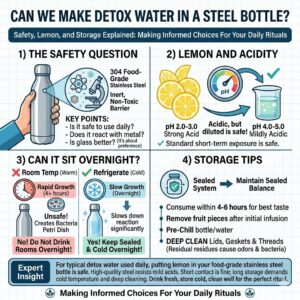
The short answer is: Yes, detox water can generally be stored safely in a high-quality stainless steel bottle, especially if it is made from food-grade stainless steel like 304 (18/8). However, storage time, acidity level, and bottle quality all matter.
This guide explains how stainless steel interacts with acidic ingredients and how to store detox water safely.
Key Takeaways
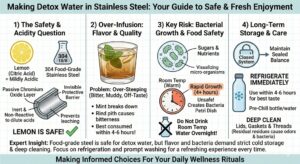
- Detox water is safe in 304 stainless steel bottles.
- Lemon does not damage high-quality stainless steel during normal use.
- Storage under 24 hours is ideal.
- Refrigeration improves freshness and safety.
- Glass is optional, not required.
- Replace bottles if interior corrosion appears.
Is It Safe to Drink Detox Water in a Steel Bottle? (Expanded, Practical + Technical)
In most everyday situations, yes—detox water (infused water) is safe to drink from a stainless steel bottle, provided the bottle is made from food-grade stainless steel and the interior surface is in good condition.
The key point is this:
The safety question is less about “detox water” itself and more about the combination of:
- acidic ingredients (lemon, citrus, berries, vinegar blends),
- contact time (minutes vs overnight vs days),
- temperature (refrigerated vs warm),
- and stainless steel grade + surface condition (304/316 vs unknown, scratched vs intact).
Stainless steel is commonly chosen for drinkware because it has strong corrosion resistance and is generally non-reactive with beverages in normal use—but “stainless” does not mean “invincible.” It means “resistant under typical conditions.”
What “Food-Grade Stainless Steel” Actually Means
“Food-grade” is not a single metal. It generally refers to stainless steel grades that are widely accepted for food and beverage contact due to:
- stability against common food acids,
- cleanability (sanitization compatibility),
- and low risk of significant metal interaction under normal use.
For reusable bottles, the most common food-contact grades are:
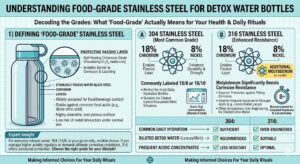
1) 304 Stainless Steel (often labeled 18/8 or 18/10)
This is the most common grade for insulated tumblers and reusable bottles.
- 18/8 typically refers to ~18% chromium and ~8% nickel
- 18/10 is similar but with slightly more nickel (often used in premium kitchenware)
This composition matters because chromium enables the protective surface layer described below.
2) 316 Stainless Steel (higher corrosion resistance)
316 contains molybdenum, which improves resistance to certain corrosive environments. In drinkware, 316 can be marketed as “more corrosion resistant,” especially for frequent exposure to acidic liquids—but 304 is already suitable for most hydration use.
Practical takeaway: For typical lemon/cucumber/mint infused water consumed the same day, 304 is generally sufficient when the bottle is reputable and intact.
Why Stainless Steel Is Usually Non-Reactive: The Chromium Oxide “Passive” Layer
Stainless steel’s corrosion resistance comes from a phenomenon called passivation.
When stainless steel is exposed to oxygen, chromium in the alloy forms a microscopic, invisible protective film called a:
- chromium oxide layer (also called a passive layer)
This layer acts as a barrier that:
- reduces direct metal contact with liquids,
- limits rust formation,
- and improves resistance to mild acids found in foods and beverages.
That’s why stainless steel is widely used in:
- dairy and beverage processing equipment,
- food preparation surfaces,
- brewing and restaurant-grade containers.
In other words, using stainless steel for infused water is not a “hack.” It’s consistent with how food-grade equipment is designed in professional environments.
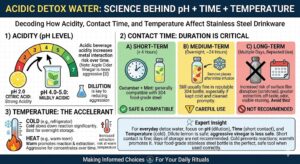
Acidic Detox Water: What Actually Matters (pH + Time + Temperature)
Detox water commonly includes acidic components:
- lemon or lime (citric acid),
- berries (organic acids),
- pineapple (acids + enzymes),
- sometimes vinegar (acetic acid, significantly more aggressive).
Acidic beverages can increase the chance of metal interaction over long contact times—especially if the surface is damaged or the steel grade is unknown. But the important nuance is:
Short-term contact is not the same as long-term storage.
Short-term (a few hours)
For most people:
- lemon slices in water for a few hours,
- cucumber + mint overnight (especially refrigerated), is generally compatible with food-grade stainless steel.
Medium-term (overnight to ~24 hours)
Still usually fine in a reputable 304 bottle, especially if:
- the bottle is kept cold,
- fruit pieces are removed after infusion,
- the bottle is cleaned promptly after use.
Long-term (multiple days, repeated storage without cleaning)
This is where problems become more plausible:
- stronger acidic extraction,
- more opportunity for surface film disruption (especially at scratched spots),
- greater chance of off-taste, odor, or visible staining.
So the “risk” is rarely immediate toxicity—it’s durability, taste changes, and surface wear over time.
Does Stainless Steel “Leach” Into Detox Water?
A common LSI question is metal “leaching.” In practical consumer terms:
- High-quality food-grade stainless steel is designed to have very low interaction with beverages under normal use.
- However, the potential for measurable metal release can increase if:
- the bottle is low-grade or unlabeled,
- the interior is scratched/pitted,
- acidic liquid is stored warm for long periods,
- the bottle is not cleaned and residue builds up.
Most users will never notice this as a health event. The more common “signal” is:
- metallic taste, or
- visible surface changes (spots, discoloration, pitting).
If you notice those, treat it as a quality/surface integrity issue and stop using that bottle for acidic infusions.
When Detox Water in Steel Is Not a Good Idea
Even if stainless steel is generally safe, there are clear cases where glass is the better choice or where you should change your storage habits:
- You store lemon/vinegar infusions for multiple days
- You regularly leave infused water in heat (car, sunlight, warm room)
- Your bottle has interior scratches, pitting, or rust spots
- Your bottle is unlabeled “stainless steel” with unknown grade
- Your infusion is unusually acidic (lemon + vinegar + long steep time)
In these scenarios, stainless steel may still “work,” but the probability of taste change or surface wear is higher. Glass is inert and eliminates those uncertainties for long infusions.
Quick Self-Check: Is Your Steel Bottle “Safe Enough” for Detox Water?
Use this practical checklist:
- Grade clarity: Does the brand specify 18/8 (304) or 316?
- Interior condition: Any scratches, dull pitting, rust-like dots?
- Taste check: Any persistent metallic taste with citrus infusions?
- Odor check: Does the bottle smell sour even after cleaning (often lid/gasket)?
- Cleaning reality: Can you fully wash and dry the lid + gasket?
If the grade is unknown and the interior looks worn, keep it for plain water and use glass for acidic infusions.
Best Practices (If You Want Steel + Detox Water With Minimal Downsides)
- Prefer a reputable bottle that states 304 (18/8) or 316
- Keep infusion time reasonable (ideally same-day)
- Refrigerate if storing overnight
- Remove citrus slices after infusion rather than leaving them for days
- Wash promptly with warm water + mild detergent
- Disassemble and clean the lid/gasket (odor usually lives there)
These habits reduce the two biggest practical problems: taste/odor retention and long contact with acid.
Is It Okay to Put Lemon in Stainless Steel?
This is the most common concern. Lemon is acidic due to its citric acid content, and many people worry that acid may react with metal.
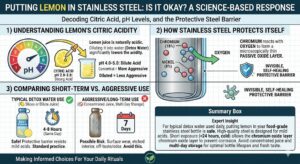
Understanding Lemon’s Acidity
Lemon juice has a pH of about 2–3, which makes it acidic. Acidic beverages can react with certain metals, especially low-quality or unprotected metal surfaces.
However, high-quality stainless steel is specifically designed to resist mild acids.
What Happens with Short-Term Exposure?
For typical daily detox water use:
- Adding lemon slices for several hours is generally safe.
- Drinking lemon-infused water from a 304 stainless steel bottle is safe.
- The protective chromium oxide layer prevents significant corrosion.
In normal conditions, lemon does not “eat away” at stainless steel.
When Can Lemon Cause Issues?
Problems are more likely if:
- The bottle is made from low-grade steel
- The interior surface is scratched or damaged
- The bottle is old and the protective layer has worn down
- Highly acidic liquid is stored for extended periods (multiple days)
If corrosion were to occur, you might notice:
- Metallic taste
- Surface discoloration
- Small rust spots
These are uncommon in high-quality bottles but possible in low-grade or damaged ones.
Can Detox Water Be Kept in a Steel Container Overnight?
Yes, detox water can typically be stored in a stainless steel bottle overnight, especially if refrigerated.
Recommended Storage Duration
For best taste and safety:
- 6–12 hours: Ideal for flavor infusion
- Up to 24 hours: Generally safe in high-quality bottles
- Beyond 24 hours: Quality may decline, especially with citrus
The main concern is not toxicity but flavor and freshness. After prolonged exposure:
- Fruit may begin to break down
- Acidity may increase
- Taste may become bitter
Refrigeration helps slow these changes.
How Does Temperature Affect Detox Water in Steel Bottles?
Temperature plays a role in both infusion and material interaction.
Cold Storage
- Slows chemical reactions
- Preserves freshness
- Minimizes corrosion risk
Warm Conditions
- Accelerates flavor extraction
- Increases acidity concentration
- May slightly increase interaction risk over long periods
This is why detox water should not be left in a hot car or in direct sunlight for extended periods.
Is It Necessary to Use a Glass Bottle for Detox Water?
No, it is not necessary—but glass has different properties.
Advantages of Glass Bottles
- Completely inert
- Does not react with acidic beverages
- No risk of metallic taste
Glass is chemically stable and does not corrode.
Disadvantages of Glass Bottles
- Fragile and breakable
- Heavier
- Typically not insulated
- Less suitable for travel or outdoor use
Stainless steel, especially insulated bottles, provides:
- Better durability
- Temperature retention
- Lighter weight
- Travel convenience
Stainless Steel vs Glass for Detox Water
| Feature | Stainless Steel | Glass |
| Acid Resistance | High (304/316) | Very High |
| Break Risk | Low | High |
| Insulation | Yes (double-wall) | Usually No |
| Weight | Moderate | Heavy |
| Durability | Excellent | Fragile |
For everyday hydration and portability, stainless steel is practical and safe. Glass may be preferred for long-term stationary storage.
What Not to Put in a Stainless Steel Bottle
While detox water is generally safe, some guidelines help maintain bottle longevity.
Avoid:
- Extremely concentrated acidic solutions stored for multiple days
- Salt-heavy solutions for prolonged periods
- Fermented beverages left for extended time
Short-term use is typically fine. Long-term storage of strong acids is not recommended.
Signs Your Steel Bottle Should Not Be Used for Detox Water
Check your bottle if you notice:
- Interior scratches or pitting
- Rust spots
- Metallic smell or taste
- Flaking interior coating (if coated)
If the protective surface is damaged, replacement is safer than continued use.
Best Practices for Making Detox Water in Stainless Steel
To maximize safety and freshness:
- Use high-quality 304 or 316 stainless steel bottles.
- Limit storage time to under 24 hours.
- Refrigerate when possible.
- Remove fruit pieces after 12–24 hours.
- Rinse and clean bottle thoroughly after use.
Proper cleaning prevents buildup of residues that could compromise surface integrity over time.
Does Stainless Steel Leach Metal into Detox Water?
In properly manufactured food-grade stainless steel, metal leaching is extremely minimal under normal use conditions.
The chromium oxide layer acts as a protective barrier. Unless the surface is severely damaged or exposed to prolonged harsh acidic environments, leaching risk remains low.
Most reputable bottle brands use stainless steel specifically because it is stable for food and beverage contact.
Final Verdict
Yes, you can safely make detox water in a stainless steel bottle—provided it is made from food-grade stainless steel and used properly.
Lemon and other mildly acidic fruits are safe for typical daily infusion periods. There is no need to switch to glass unless you prefer it or plan to store highly acidic beverages for extended durations.
For daily hydration, travel, and temperature control, stainless steel remains one of the safest and most durable options.
FAQ
Is it safe to drink detox water in a steel bottle? Yes, if the bottle is made from food-grade stainless steel such as 304 or 316.
Can detox water be kept in a steel container overnight? Yes, especially if refrigerated. Ideally consume within 24 hours.
Is it necessary to use a glass bottle for detox water? No. Glass is inert but more fragile. Stainless steel is safe for regular use.
Is it okay to put lemon in stainless steel? Yes, for normal infusion periods. Avoid storing highly acidic liquids for multiple days.