Can I Store Wine in a Steel Bottle? Safety, Flavor, and Storage Explained
Many people assume stainless steel is completely neutral and safe for any beverage. After all, it’s used in professional kitchens, breweries, and even wineries. So it’s natural to ask:
- Can I store wine in a steel bottle?
- Is it okay to put wine in stainless steel?
- Is alcohol safe on stainless steel?
- What shouldn’t be stored in stainless steel?
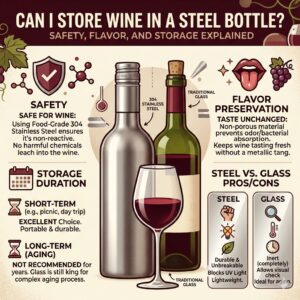
The short answer is: Yes, you can store wine in a food-grade stainless steel bottle for short periods of time. However, it is not ideal for long-term storage or aging.
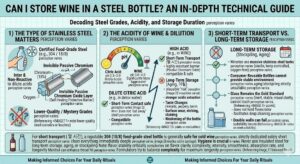
To understand why, we need to look at three key factors:
- The type of stainless steel
- The acidity of wine
- The difference between short-term transport and long-term storage
Key Takeaways
- Food-grade stainless steel is safe for short-term wine storage.
- Alcohol itself does not aggressively react with stainless steel.
- Wine’s acidity is the primary concern.
- Long-term aging should be done in glass.
- Stainless steel bottles are best for transport, not cellaring.
Is It Okay to Put Wine in Stainless Steel?
The Type of Stainless Steel Matters
Not all steel is the same. When discussing beverage safety, the relevant term is food-grade stainless steel, typically:
- 304 stainless steel (18/8)
- 316 stainless steel (marine-grade, more corrosion resistant)
These grades are:
- Resistant to rust
- Non-reactive under normal food contact conditions
- Widely used in food processing equipment
Many wineries actually ferment and store wine in large stainless steel tanks. This often confuses people into thinking stainless steel is always ideal for wine storage.
But industrial tanks differ significantly from portable bottles.
Why Wineries Use Stainless Steel (And Why That’s Different)
Commercial stainless steel wine tanks are:
- Highly polished internally
- Engineered for controlled environments
- Temperature-regulated
- Oxygen-managed
- Designed for specific fermentation stages
They are not the same as:
- Insulated tumblers
- Travel bottles
- Everyday steel water bottles
The engineering precision and scale make a major difference.
Is Alcohol Safe in Stainless Steel?
From a chemistry standpoint:
Ethanol (alcohol) itself is not highly corrosive to food-grade stainless steel.
Pure alcohol does not aggressively react with 304 or 316 stainless steel.
However, wine is not just alcohol.
Wine contains:
- Organic acids (tartaric, malic, lactic acids)
- Tannins
- Sugars
- Phenolic compounds
Wine typically has a pH between 3 and 4, meaning it is acidic.
Acidity is what changes the equation.
Does Wine React with Stainless Steel?
Under normal short-term conditions, wine does not significantly corrode food-grade stainless steel.
However, prolonged exposure to acidic liquids can:
- Stress the protective chromium oxide layer
- Increase the chance of surface degradation over time (especially if scratched)
- Slightly alter taste in rare cases
The risk is low with high-quality steel, but it increases with:
- Lower-grade steel
- Damaged interior surfaces
- Extended storage periods
Short-Term vs Long-Term Storage
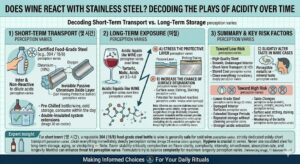
Short-Term Storage (Hours to a Few Days)
Storing wine in a stainless steel bottle for:
- Picnics
- Outdoor events
- Travel
- Day trips
is generally considered safe if the bottle is:
- Food-grade
- Clean
- Not scratched internally
In fact, insulated steel bottles offer benefits:
- Temperature retention
- Light protection
- Durability
For short-term transport, stainless steel performs well.
Long-Term Storage (Weeks to Months)
Wine is traditionally stored in:
- Glass bottles
- Oak barrels
Why?
Because wine continues to evolve over time. Long-term storage requires:
- Controlled oxygen exposure
- Stable chemical environment
- Neutral material interaction
Stainless steel bottles are not designed for wine aging.
Potential long-term issues include:
- Subtle flavor flattening
- Lack of micro-oxygenation (important for aging)
- Seal degradation in non-wine-specific lids
- Increased oxidation if not properly sealed
Wine stored for weeks or months in a casual steel bottle is unlikely to improve in quality.
Will Wine Taste Different in a Steel Bottle?
For short periods, most people will not notice a difference.
However, over extended storage:
- Flavor brightness may decline
- Aroma complexity may reduce
- The wine may taste “closed” or flat
This is not necessarily because steel chemically alters wine, but because:
- Stainless steel does not allow gradual oxygen exchange
- Portable bottles are not engineered for aging
Glass remains the gold standard for preserving wine character.
Stainless Steel vs Glass for Wine Storage
| Factor | Stainless Steel | Glass |
| Chemical Neutrality | High | Very High |
| Light Protection | Excellent | Depends (clear vs dark) |
| Durability | Very High | Breakable |
| Long-Term Aging | Not Ideal | Ideal |
| Temperature Retention | High (insulated) | Low |
| Flavor Preservation (Short-Term) | Good | Excellent |
| Flavor Preservation (Long-Term) | Limited | Excellent |
Glass remains superior for long-term storage and aging.
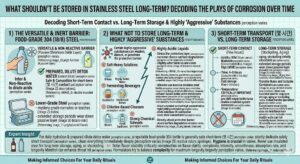
What Shouldn’t Be Stored in Stainless Steel?
Although stainless steel is versatile, certain substances are not ideal for long-term storage.
Avoid storing long-term:
- Highly acidic liquids (vinegar, citrus concentrate)
- Salt-heavy solutions
- Fermenting beverages
- Chlorine-based cleaners
- Strong chemical solvents
These substances can weaken protective layers or affect taste over time.
Wine falls into the “mildly acidic” category, which is acceptable short-term but not optimal long-term.
Does Alcohol Corrode Stainless Steel?
Pure alcohol does not significantly corrode food-grade stainless steel.
Problems arise when alcohol is combined with:
- Acids
- Chlorides
- Salts
Wine’s acidity is the more relevant factor—not the alcohol content itself.
Best Practices If You Store Wine in a Steel Bottle
If you decide to use stainless steel for wine transport:
- Use only 304 or 316 food-grade stainless steel.
- Avoid storing for more than a few days.
- Do not use scratched or damaged bottles.
- Clean thoroughly before and after use.
- Avoid storing highly tannic wine for extended periods.
- Do not freeze wine in a sealed steel bottle.
Final Verdict
Yes, you can store wine in a stainless steel bottle for short-term use. It is generally safe, especially with high-quality food-grade steel.
However:
- Stainless steel is not ideal for long-term wine storage.
- Wine’s acidity makes glass a better long-term material.
- Portable steel bottles are not designed for aging or preserving complex wine characteristics.
For picnics or travel, stainless steel works well.
For aging and preserving wine quality, glass remains the superior choice.
FAQ
Can wine corrode stainless steel? Not significantly in short-term contact, especially with food-grade 304 or 316 steel.
Can I put red wine in a stainless steel tumbler? Yes for short-term use, but not for long-term storage.
Does wine taste metallic in stainless steel? Usually no, unless stored for extended periods or in low-quality steel.
Is alcohol safe in stainless steel? Yes. Pure alcohol does not strongly react with food-grade stainless steel.