Are Gel Pens Rollerballs? A Technical Comparison of Ink, Performance, and Use Cases
Introduction
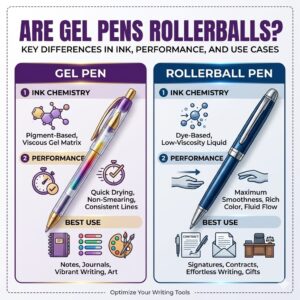
Gel pens and rollerball pens are often grouped together because both use a rolling ball tip and deliver smooth, fluid writing. This leads to a common question: are gel pens simply a type of rollerball?
The short answer is: gel pens are a subtype of rollerball pens—but with fundamentally different ink chemistry and performance behavior.
From a product design and manufacturing perspective, the distinction lies in how the ink is formulated and controlled. That difference directly affects writing feel, drying speed, smudge resistance, color vibrancy, and long-term durability.
In this guide, we break down the differences across mechanism, ink composition, and real-world use cases—so you can choose the right pen for signing, note-taking, or professional applications.
Mechanism and Ink Chemistry
How Gel Pens and Rollerballs Deliver Ink
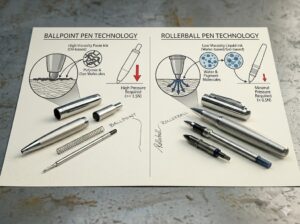
Both gel pens and rollerball pens use a ball-and-socket mechanism:
- A small metal ball (typically steel or tungsten carbide) rotates as you write
- Ink is transferred from an internal reservoir to the paper
However, the delivery mechanism behind the ball differs:
Rollerball pens (liquid ink):
- Use low-viscosity, water-based ink
- Ink flows via capillary action and gravity
- Continuous ink feed with minimal resistance
Gel pens:
- Use pigment-based ink suspended in a gel matrix
- Flow is controlled by shear-thinning behavior (ink becomes fluid when writing pressure is applied)
- More controlled release compared to liquid rollerball ink
From an engineering standpoint, gel ink behaves as a non-Newtonian fluid, meaning its viscosity changes under stress. This allows gel pens to combine smooth writing with better control.
Relationship Between Ink Composition and Writing Feel
Ink formulation directly determines user experience:
- Rollerball ink → thinner, flows faster → very smooth but less controlled
- Gel ink → thicker at rest, fluid under motion → smooth with added stability
In real usage:
- Rollerballs feel “wet” and free-flowing
- Gel pens feel smooth but slightly more controlled and precise
Practical Implications for Maintenance and Longevity
Rollerball pens:
- More prone to leakage due to low viscosity
- Can dry out if left uncapped
- Require tighter sealing design
Gel pens:
- Less leakage risk
- More stable during storage
- Still susceptible to drying if exposed to air
According to general writing instrument standards such as ISO 14145 (rollerball pens), liquid ink systems must meet stricter flow consistency requirements, while gel systems are optimized for balance between flow and control.
Ink Viscosity: Gel vs Liquid
Differences in Viscosity and Flow Behavior
Viscosity is the key technical difference:
- Rollerball ink: ~2–10 mPa·s (very low viscosity)
- Gel ink: ~100–1000 mPa·s (moderate viscosity, shear-thinning)
This means:
- Rollerball ink flows almost immediately upon contact
- Gel ink requires slight movement or pressure to activate flow
Impact on Line Thickness and Consistency
Rollerball pens:
- Produce darker, more saturated lines
- Higher ink output per stroke
- More variation with writing speed
Gel pens:
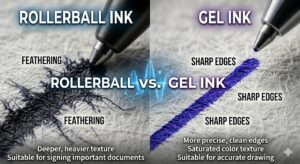
- More uniform line thickness
- Better edge definition
- Reduced ink pooling
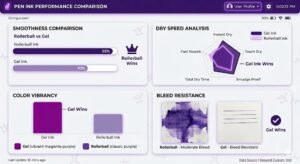
From testing, gel pens tend to provide cleaner lines on standard office paper, while rollerballs may feather or spread depending on paper quality.
Smudge Resistance and Drying Time
Drying Behavior on Paper
Rollerball ink:
- Slower drying
- Absorbs into paper fibers
- Remains wet on surface longer
Gel ink:
- Faster drying (especially modern quick-dry formulations)
- Sits partially on surface
- Less penetration than liquid ink
Drying behavior depends on both ink formulation and paper absorbency.
Smudge Resistance
Rollerball pens:
- Higher smudge risk
- Not ideal for left-handed writers
Gel pens:
- Better smudge resistance
- More suitable for fast writing
From user feedback, gel pens are often preferred in environments where clean, fast-drying writing is required, such as classrooms or exams.
Color Vibrancy and Archival Quality
Brightness and Saturation
Rollerball pens:
- Use dye-based ink
- Produce deep, rich tones
- Slightly less opaque
Gel pens:
- Use pigment-based ink
- Higher opacity
- Brighter and more vivid colors
This is why gel pens dominate in:
- Colored writing
- Design and illustration
- Highlighting and decorative use
Fade Resistance and Archival Considerations
Pigment-based gel ink:
- More resistant to UV fading
- Better long-term color stability
Dye-based rollerball ink:
- More prone to fading over time
- Less suitable for archival documents
For document permanence, standards such as ISO 12757 (documentary ink performance) emphasize resistance to water, light, and chemical exposure.
Practical Guide: Choosing for Signing vs Note-Taking
When to Choose for Signing
Use rollerball pens if:
- You want smooth, elegant signatures
- Paper quality is high
- Immediate drying is not critical
Use gel pens if:
- You need cleaner lines
- You want faster drying
- You are signing multiple documents quickly
When Note-Taking Favors Each Type
Gel pens are ideal for:
- Daily note-taking
- Students and professionals
- Fast writing without smudging
Rollerball pens are better for:
- Journaling
- Creative writing
- Situations where writing feel is prioritized
Quick Decision Framework
Choose a gel pen if you need:
- Fast drying
- Smudge resistance
- Bright, vivid colors
Choose a rollerball pen if you want:
- Maximum smoothness
- Dark, fluid ink
- Premium writing feel
Conclusion
Gel pens and rollerball pens share a similar external design, but they are not the same in performance or ink technology. Gel pens are essentially a specialized category within rollerball systems, distinguished by their gel-based, shear-thinning ink formulation.
The key differences come down to:
- Ink chemistry (gel vs liquid)
- Writing control vs fluidity
- Drying speed and smudge resistance
- Color vibrancy and durability
The best choice depends on your writing environment, paper type, and personal preference. For most everyday tasks, gel pens offer a balanced solution. For premium writing experiences, rollerballs remain a strong choice.
Testing both in your typical use scenario remains the most reliable way to determine which suits you best.
FAQ
Are gel pens rollerball pens the same thing?
Not exactly. Gel pens are a subtype of rollerball pens, but they use different ink chemistry and behave differently in writing.
Which dries faster, gel or rollerball ink?
Gel ink generally dries faster due to its higher viscosity and formulation.
Can rollerballs be used for archival documents?
They can be used, but pigment-based gel inks are typically more resistant to fading and better suited for archival purposes.
How do I prevent smudging with gel or rollerball pens?
Use quick-drying ink formulations, avoid excessive ink flow, and allow a brief drying period—especially with rollerball pens.