Why Is My Insulated Water Bottle Sweating?
Introducción
Insulated water bottles are designed to keep beverages hot or cold while preventing condensation on the outside. That is one of their biggest advantages over standard single-wall bottles. So when you notice your insulated bottle “sweating,” it can be both confusing and concerning.
In most cases, sweating is not caused by a leak and does not mean the bottle is immediately defective. Instead, it is usually the result of environmental conditions interacting with temperature differences. However, there are situations where sweating indicates a more serious issue, such as insulation failure.
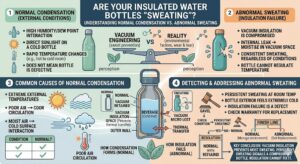
From a practical standpoint, bottle sweating can be divided into two main categories:
- Normal condensation caused by humidity and temperature differences
- Abnormal sweating caused by compromised insulation
Understanding which situation applies to your bottle is critical. A small amount of condensation under certain conditions is normal, but persistent or excessive sweating often signals that the bottle is no longer performing as intended.
This guide provides a detailed explanation of:
- how condensation forms
- how insulated bottles are engineered to prevent it
- the most common causes of sweating
- how to reduce or eliminate the issue
- when sweating indicates a defect
Understanding Condensation on Insulated Bottles
What “Sweating” Actually Means
When a bottle appears to sweat, the moisture you see is not coming from inside the bottle. Instead, it is water vapor from the surrounding air that has condensed on the bottle’s surface.
Air naturally contains moisture in the form of invisible vapor. When this air comes into contact with a surface that is colder than the air itself, the vapor turns into liquid droplets. This process is called condensation.
This means:
- your bottle is not leaking
- the moisture is external
- the cause is environmental, not internal
The Science Behind Condensation
Condensation is governed by temperature and humidity. The key concept here is the dew point, which is the temperature at which air can no longer hold moisture.
When the surface of your bottle drops below the dew point:
- moisture in the air condenses
- droplets form on the surface
According to thermal principles outlined by the U.S. Department of Energy, condensation occurs when there is a sufficient temperature difference between a surface and the surrounding air.
For example:
- Air temperature: 30°C with high humidity
- Bottle surface: 5°C
This creates ideal conditions for condensation.
Why Insulated Bottles Are Designed to Prevent Sweating
High-quality insulated bottles use double-wall vacuum insulation. This design is specifically intended to prevent condensation.
The structure works as follows:
- two walls (inner and outer)
- a vacuum layer between them
- minimal heat transfer between layers
Because the vacuum blocks heat transfer:
- the inside remains cold or hot
- the outside stays close to room temperature
If the outer surface does not get cold, condensation should not form.
Therefore, in ideal conditions:
- a properly functioning insulated bottle should not sweat
Factors That Cause Sweating on a Bottle
Temperature Difference Between Inside and Outside
The most important factor is the temperature gap between the liquid inside the bottle and the surrounding air.
Examples of high-risk scenarios:
- ice water inside the bottle in a hot room
- cold drinks in direct sunlight
- refrigerated bottles brought into warm environments
The larger the temperature difference, the higher the likelihood of condensation.
Humidity Levels
Humidity plays an equally important role.
In environments with high humidity:
- the air contains more water vapor
- condensation forms more easily
Common high-humidity environments include:
- gyms
- kitchens
- tropical climates
- bathrooms
This is why bottles tend to sweat more in these locations.
Airflow and Exposure
Air movement can also influence condensation.
- still air may allow moisture to settle
- moving air can increase heat exchange
Additionally, placing a bottle on surfaces like wood or fabric can trap moisture, making sweating more noticeable.
Bottle Construction and Materials
How Vacuum Insulation Prevents Condensation
Vacuum insulation works by reducing three forms of heat transfer:
- conduction (through solids)
- convection (through air movement)
- radiation (heat transfer via waves)
The vacuum layer eliminates convection and greatly reduces conduction.
As a result:
- the outer surface does not cool down significantly
- condensation is minimized
Material Impact on Sweating
Different materials perform differently:
表格 还在加载中,请等待加载完成后再尝试复制
Only vacuum-insulated stainless steel bottles reliably prevent condensation in most environments.
Common Design Flaws and Wear Issues
Vacuum Seal Failure
The most common reason for unexpected sweating is a failed vacuum seal.
Causes include:
- dropping the bottle
- manufacturing defects
- long-term wear
Once the vacuum seal is broken:
- air enters the insulation layer
- heat transfer increases
- the outer surface becomes cold
This leads to condensation.
Internal Structural Damage
Even small internal cracks can:
- disrupt insulation
- reduce performance
- cause uneven temperature distribution
This type of damage is often invisible from the outside.
Lid and Gasket Issues
Sometimes sweating occurs near the top of the bottle.
Possible causes:
- worn silicone seals
- improperly tightened lid
- degraded gasket
These issues can allow heat exchange and localized condensation.
Practical Ways to Reduce Sweating
Pre-Chilling or Pre-Warming
Before filling your bottle:
- rinse with cold water for cold drinks
- rinse with warm water for hot drinks
This reduces temperature shock and stabilizes internal conditions.
Avoid Extreme Temperature Loads
Using excessive ice or very hot liquids can create large temperature differences.
Moderating temperature levels helps reduce condensation.
Use Insulating Sleeves
Bottle sleeves can:
- absorb moisture
- reduce surface temperature changes
- improve grip
They are especially useful in humid environments.
Adjust Usage Environment
Whenever possible:
- keep bottles out of direct sunlight
- avoid placing them in hot environments
- use them in temperature-controlled spaces
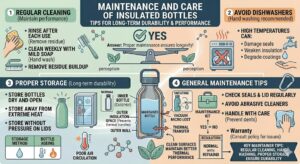
Maintenance and Care
Limpieza regular
- rinse after each use
- clean weekly with mild soap
- remove residue buildup
Clean surfaces maintain better thermal performance.
Avoid Dishwashers
High temperatures can:
- damage seals
- weaken insulation
- degrade coatings
Hand washing is recommended for most insulated bottles.
Proper Storage
Store bottles:
- dry and open
- away from extreme heat
- without pressure on lids
This helps maintain long-term durability.
When Sweating Signals a Bigger Issue
Signs of Insulation Failure
You should be concerned if:
- sweating appears suddenly
- The bottle feels cold on the outside
- drinks no longer stay cold or hot
These indicate that insulation may be compromised.
Warranty and Replacement
Most reputable brands offer warranties for insulation failure.
If you suspect a defect:
- document the issue
- take photos
- contact customer support
Many manufacturers will replace defective products.
Real-World Insight
From product testing across multiple brands:
- new vacuum-insulated bottles rarely sweat
- mid-range plastic bottles show occasional condensation
- damaged bottles consistently sweat
A key takeaway is that not all bottles labeled “insulated” use true vacuum insulation.
Conclusión
Sweating on an insulated water bottle is usually caused by environmental conditions such as temperature differences and humidity. In these cases, it is harmless and temporary.
However, if sweating becomes persistent or appears alongside poor temperature retention, it is likely due to insulation failure.
Key points to remember:
- Condensation is caused by external moisture
- vacuum insulation should prevent sweating
- environmental conditions matter
- sudden sweating often indicates damage
By understanding how your bottle works and maintaining it properly, you can reduce condensation and extend its lifespan.
Preguntas frecuentes
Why does my bottle sweat after bringing it indoors?
Because warm indoor air meets a cold surface, causing condensation.
Is sweating harmful?
No. It only affects the outside of the bottle and does not impact the liquid inside.
When should I contact the manufacturer?
If sweating is combined with poor insulation performance, it may indicate a defect and should be reported.