
Vacuum Bottle vs Thermos: What’s the Difference and Which One Should You Choose?
Introduction: The Confusion Between “Thermos” and “Vacuum Bottle”
If you search for drinkware online, you’ll quickly notice something confusing:
Some products are called thermos, others are labeled vacuum bottles, and sometimes you’ll see terms like insulated bottle or thermoflask used interchangeably.
So what’s the real difference?
From a technical standpoint, most of these products are built on the same core principle—vacuum insulation. However, the terminology varies depending on whether you’re looking at engineering definitions, marketing language, or brand naming.
In this guide, we’ll clarify:
- Whether a thermos and a vacuum bottle are actually different
- How vacuum insulation works compared to standard insulation
- What “thermoflask” really means
- Whether vacuum bottles can keep drinks cold
- And most importantly, what actually determines performance
What Is a Vacuum Bottle? (Technical Definition)
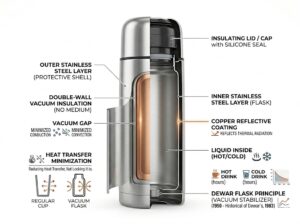
A botella de vacío, also known as a vacuum flask, is a container designed to maintain the temperature of its contents by minimizing heat transfer.
How It Works
A typical vacuum bottle consists of:
- An inner container (holds the liquid)
- An outer shell (provides structure)
- A vacuum layer between them
The vacuum layer is the key feature.
Heat transfer normally occurs through:
- conduction (direct contact)
- convection (movement of air or liquid)
- radiation (infrared heat exchange)
By removing air between the two walls, vacuum bottles effectively eliminate conduction and convection, which significantly slows down temperature change.
This principle is widely recognized in thermal engineering and forms the basis of modern insulated drinkware.
Key Takeaway
A vacuum bottle is not defined by brand or appearance—it is defined by its insulation technology.
2. What Is a Thermos? (Brand vs Generic Term) — Detailed Explanation
The term “thermos” is widely used, but often misunderstood from a technical perspective.
Originally, Thermos was a registered brand that commercialized vacuum-insulated containers in the early 20th century. Over time, as the product became mainstream, the brand name gradually evolved into a generic term in everyday language.
Why This Terminology Shift Happens
This phenomenon is not unique. In consumer markets, when a product category becomes strongly associated with a leading brand, the brand name often becomes the default descriptor.
Common examples include:
- "Kleenex” used for facial tissues
- “Google” used as a verb for searching
In the same way, “thermos” has become shorthand for any container that keeps drinks hot or cold.
The Technical vs Consumer Perspective
From an engineering standpoint:
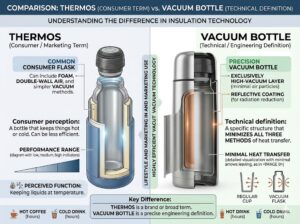
- A vacuum bottle (or vacuum flask) refers specifically to a container that uses a vacuum layer to reduce heat transfer
- “Thermos” does not define the structure, materials, or manufacturing method
This distinction matters because two products can both be called “thermos,” yet differ significantly in:
- vacuum quality
- material grade
- insulation performance
Expert Clarification
When consumers say “thermos,” they are usually referring to the function (keeping temperature), not the technology.
In technical terms, “thermos” is a naming convention, while “vacuum bottle” describes the actual insulation system.
3. Vacuum Bottle vs Thermos: What’s the Real Difference?
Beyond Definitions: Why This Comparison Exists
At first glance, comparing “vacuum bottle” and “thermos” may seem unnecessary, because they are often used interchangeably. However, this confusion actually reflects a deeper issue:
People are trying to understand whether the name implies a difference in performance
Functional Reality
From a purely functional standpoint:
- Both refer to containers designed to maintain temperature
- Both typically use vacuum insulation
- Both can achieve similar performance levels
So technically:
There is no inherent performance difference between a product labeled “thermos” and one labeled “vacuum bottle.”
Where the Real Differences Come From
In real-world products, differences arise not from terminology, but from:
- manufacturing precision
- vacuum sealing quality
- structural design
- lid engineering
This is why two bottles marketed differently can perform very differently.
Practical Insight
From a product development perspective:
- “Vacuum bottle” is the term used internally (engineering, sourcing, manufacturing)
- “Thermos” is used externally (retail, marketing, consumer search)
Expert Takeaway
Comparing “thermos” vs “vacuum bottle” is not meaningful unless you look at the actual construction.
The name does not determine performance. The engineering does.
4. Which Is Better, a Thermos or a Vacuum Flask?
Why This Question Is Misleading
This question assumes that “thermos” and “vacuum flask” are two different product categories, which is not the case.
Direct Answer (With Context)
Neither is inherently better—they describe the same type of product from different perspectives.
However, this answer alone is not enough. What users actually want to know is:
Which product performs better in real use?
What Actually Determines Performance
From an engineering and manufacturing standpoint, performance depends on:
1. Vacuum Quality
The most critical factor.
- A high-quality vacuum minimizes heat transfer
- Even slight leakage significantly reduces insulation performance
2. Material Selection
Most high-performance bottles use stainless steel (304 or 316), not because it “keeps heat better,” but because it:
- supports stable vacuum construction
- resists deformation and corrosion
- maintains structural integrity over time
3. Lid and Sealing Design
In practical testing, a large portion of heat loss occurs through:
- the lid
- the opening interface
A poorly designed lid can reduce overall performance, even if the vacuum body is well made.
Real-World Insight
Two bottles can both be called “thermos”:
- one may keep water hot for 12–24 hours
- another may lose heat within 4–6 hours
The difference is not the name—it is the manufacturing quality and design execution
Expert Conclusion
Instead of asking which is better, focus on how the product is built. Terminology does not affect performance—engineering does.
5. What Is the Difference Between Insulated and Vacuum Bottles?
Why This Distinction Matters
This is one of the most important conceptual differences, especially for SEO and product positioning.
Many users assume that all “insulated bottles” perform similarly, but this is not true.
Insulated Bottles: A Broad Category
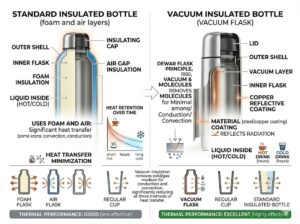
An insulated bottle simply refers to any container that reduces heat transfer.
This can include:
- single-wall bottles with insulating coatings
- double-wall bottles with air gaps
- foam-insulated containers
These methods provide basic thermal resistance, but are limited in effectiveness.
Vacuum Bottles: A Specific Technology
A vacuum bottle is a subset of insulated bottles that uses:
- double-wall construction
- a vacuum layer between walls
Because there is no air in the vacuum space:
- conduction is minimized
- convection is eliminated
This makes vacuum insulation significantly more efficient.
Performance Implications
In controlled comparisons:
- standard insulated bottles provide moderate temperature retention
- vacuum bottles provide long-term temperature stability
Key Principle
All vacuum bottles are insulated, but not all insulated bottles use vacuum technology.
This is a critical distinction for both product selection and SEO positioning.
6. Is a Thermoflask the Same as a Vacuum Flask?
Understanding the Term “Thermoflask”
“Thermoflask” is not a formal engineering term. It is primarily used in:
- marketing materials
- product listings
- e-commerce search optimization
What It Usually Refers To
In most cases:
- “thermoflask” = vacuum flask
The term combines:
- “thermo” (temperature control)
- “flask” (container)
Why It Exists
From a marketing perspective:
- it sounds more modern and descriptive
- it improves keyword coverage
- it appeals to consumer search behavior
Expert Clarification
Although the name varies, the underlying product is the same:
A thermoflask is typically a vacuum-insulated bottle, just described using a different naming convention.
7. Can You Put Cold Water in a Vacuum Flask?
Short Answer
Yes, and this is one of the most misunderstood aspects of vacuum bottles.
Why Vacuum Works for Both Hot and Cold
A vacuum does not “generate heat” or “keep things hot.” It simply reduces heat transfer between the inside and outside.
This works in both directions:
- prevents heat from escaping (hot drinks stay hot)
- prevents heat from entering (cold drinks stay cold)
Technical Explanation
In a vacuum-insulated system:
- there is no air to carry heat (no convection)
- minimal direct contact (limited conduction)
This slows down temperature equalization regardless of direction.
Real-World Applications
Vacuum bottles are widely used for:
- cold water during workouts
- iced beverages
- outdoor activities in hot environments
Practical Insight
Performance for cold retention can sometimes be even more noticeable than for hot liquids, especially when:
- the bottle is pre-cooled
- the lid is kept closed
- the environment is warm
Key Takeaway
A vacuum flask does not distinguish between hot and cold—it simply slows down temperature change.
8. What Actually Determines a Good Vacuum Bottle?
Moving Beyond Terminology
At this stage, it becomes clear that naming is irrelevant. What matters is how well the product is engineered and manufactured.
Core Performance Factors
1. Vacuum Integrity
This is the single most important factor.
- determines insulation efficiency
- directly affects heat retention duration
2. Structural Design
Includes:
- wall thickness
- welding precision
- overall geometry
These influence durability and vacuum stability.
3. Lid Engineering
Often underestimated, but critical.
- affects heat loss
- determines sealing performance
- impacts usability
Real Industry Insight
In production, the biggest difference between low-cost and high-quality bottles is not the visible material, but:
- vacuum sealing accuracy
- consistency in manufacturing
- quality control standards
Expert Conclusion
A good vacuum bottle is defined by precision manufacturing, not by branding or naming.
9. Why Stainless Steel Vacuum Bottles Are the Modern Standard
Market Shift: From Function to Lifestyle
Consumer expectations have evolved.
Today, users prioritize:
- portability
- durability
- multi-scenario usability
Why Stainless Steel Fits These Needs
Stainless steel vacuum bottles offer:
- high structural strength
- resistance to impact
- long service life
- compatibility with modern design trends
Practical Product Direction
Products like the Stainless Steel Water Bottle represent how modern vacuum bottles are designed.
They combine:
- double-wall vacuum insulation
- food-grade stainless steel
- lightweight, portable structure
These features align with real-world usage, including commuting, fitness, and travel.
Conclusion: It’s Not About the Name—It’s About Performance
The debate between “vacuum bottle” and “thermos” is largely a matter of terminology.
What truly matters is:
- insulation technology
- material quality
- design and usability
A well-designed vacuum bottle will perform the same regardless of what it is called.
Final Thought
The best bottle is not defined by its name, but by how well it performs in your daily routine.