 How Does a Vacuum Bottle Work? (Science, Structure & Real-World Performance Explained)
Introducción
Why does your coffee stay hot for hours in a vacuum bottle—but cool down quickly in a regular cup?
The answer lies in physics, not magic.
A vacuum bottle (also known as a thermos) is designed to minimize heat transfer, allowing liquids to stay hot or cold for extended periods. But many users misunderstand how it actually works—and why performance varies so much between products.
From a manufacturing and materials perspective, a vacuum bottle is essentially a controlled thermal system, combining structural design, material science, and sealing technology.
In this guide, we’ll break down:
- The science behind heat retention
- How each component contributes to performance
- Why some bottles outperform others
- Practical tips for choosing and maintaining one
What Is a Vacuum Bottle?
Basic Definition
A vacuum bottle is a double-walled container with a vacuum layer between the inner and outer walls, designed to reduce heat transfer.
Unlike regular bottles:
- It does not actively generate heat
- It simply slows down heat loss or heat gain
Key Components Overview
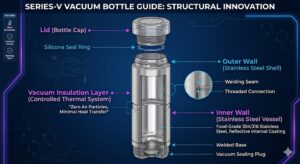
A typical vacuum bottle includes:
- Inner wall (holds the liquid)
- Outer wall (protects structure)
- Vacuum layer (core insulation zone)
- Lid and sealing system
Each part plays a role in thermal performance, but the vacuum layer is the most critical.
The Science Behind Vacuum Bottles
To understand how a vacuum bottle works, it helps to start with a basic principle from thermodynamics: heat always moves from a warmer area to a cooler one until the temperatures become more balanced. If you pour hot coffee into a regular mug, the heat naturally escapes into the cooler surrounding air. If you pour iced water into a container on a warm day, heat from the environment flows inward and warms the drink.
A vacuum bottle is designed to slow this process as much as possible. It does not create heat, and it does not “lock temperature permanently.” Instead, it uses structure and materials to reduce the three main paths through which heat normally travels: conduction, convection, and radiation.
The Three Types of Heat Transfer
In everyday life, most people notice that drinks cool down or warm up, but they do not usually think about the mechanism behind it. In physics, there are three primary ways heat is transferred.
1. Conduction (Heat Transfer Through Direct Contact)
Conduction happens when heat moves through a solid material from one particle to another. The hotter particles vibrate more, transferring energy to neighboring cooler particles.
A simple example is a metal spoon left in hot tea. Even if only the lower part of the spoon touches the liquid, the handle gradually becomes warm. That is conduction at work: heat moves through the metal itself.
In a normal single-wall bottle, conduction is one of the fastest ways heat escapes. The hot liquid touches the inner wall, the wall transfers heat outward, and eventually the outer surface warms up. Once the outer wall becomes warm, that heat is then lost to the surrounding environment.
This is why ordinary metal cups often feel hot to the touch when filled with hot drinks. The material is acting as a pathway for heat to move outward.
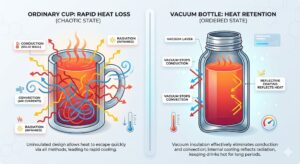
In a vacuum bottle, designers try to interrupt that pathway. The inner wall still receives heat from the drink, but because there is a vacuum gap between the inner and outer walls, there are almost no particles in that space to continue carrying the heat across. That dramatically reduces conductive heat transfer.
2. Convection (Heat Transfer Through Air or Liquid Movement)
Convection occurs when heat is transferred through the movement of fluids, including liquids and gases. Warm fluid rises, cool fluid sinks, and this circulation creates a continuous exchange of thermal energy.
For example, when you boil water, the hotter water at the bottom rises while cooler water moves down to replace it. The same thing happens in air: warm air rises above a hot surface, carrying heat away from it.
In a regular bottle or cup, convection occurs around the container and especially at the opening. Hot liquid warms the inner wall, the surrounding air is heated, and that warm air moves away, carrying energy with it. At the top opening, warm air can continuously escape while cooler air replaces it, which accelerates temperature loss.
This is one reason why drinks cool much faster in an open mug than in a sealed vacuum bottle. The open mug allows constant convective exchange with the surrounding air.
The vacuum layer in a vacuum bottle almost completely eliminates convection between the two walls because convection requires matter—air or liquid—to circulate. In a vacuum, there is no air available to rise, fall, or move. Without that medium, convective heat transfer in the insulated gap is essentially removed.
However, convection can still occur at the mouth of the bottle if the lid is open or poorly sealed. That is why the cap and sealing system are not minor details; they are critical to overall thermal performance.
3. Radiation (Heat Transfer Through Infrared Energy)
Radiation is different from conduction and convection because it does not require direct contact or a physical medium. Heat can also travel as electromagnetic waves, especially in the infrared part of the spectrum.
You can feel this effect when standing near sunlight or near a fire. Even if the air between you and the heat source is not extremely hot, you still feel warmth because radiant energy is traveling through space and being absorbed by your body.
Inside a vacuum bottle, even after conduction and convection are greatly reduced, radiation still remains. The hot inner wall can radiate thermal energy across the vacuum gap toward the cooler outer wall. That means a perfect vacuum alone is not enough to stop all heat transfer.
To minimize this remaining loss, many vacuum bottles use reflective inner surfaces or thin metallic coatings. These surfaces reflect infrared radiation back toward the liquid rather than allowing it to be absorbed by the outer wall. In practical terms, this means less radiant heat escapes from the drink, which helps the bottle maintain temperature for longer.
This is a very important point: the vacuum suppresses conduction and convection, while reflective surfaces help reduce radiation. High-performance thermal bottles depend on both.
How Vacuum Stops Heat Transfer
Once you understand the three heat transfer mechanisms, the logic of a vacuum bottle becomes much clearer.
A vacuum is a space where almost all air has been removed. Because there are extremely few particles left in that gap, two major forms of heat transfer are severely limited:
- Conduction is reduced because there are very few particles to pass energy from the inner wall to the outer wall.
- Convection is nearly eliminated because there is no air available to circulate.
This is why the vacuum gap is the core of the bottle’s insulation system. It acts like a thermal barrier between the liquid and the outside world.
But it is important to be precise here. A vacuum bottle does not completely stop all heat transfer. It only slows it down very effectively. Some heat still escapes through:
- Radiation across the vacuum gap
- The bottle neck and lid area
- Small structural connection points where inner and outer walls are joined
In real engineering terms, a vacuum bottle is not a zero-loss system. It is a low-loss thermal management design.
- The inner surface is often coated with reflective material
This combination dramatically slows heat exchange.
Important clarification:
A vacuum bottle does not “keep heat forever”—it simply reduces the rate of heat loss or gain
Structure Breakdown: How Each Part Works
Double-Wall Stainless Steel Design
Most modern vacuum bottles use:
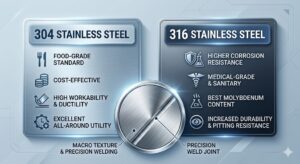
- Acero inoxidable 304 (food-grade standard)
- 316 stainless steel (higher corrosion resistance)
Why stainless steel?
- Durable and impact-resistant
- Safe for food contact
- Low thermal conductivity compared to other metals
Vacuum Layer (Core Technology)
The vacuum is created by:
- Removing air between the two walls
- Sealing space permanently
Why This Is Critical
If the vacuum fails:
- Air enters the gap
- Conduction and convection resume
- Insulation performance drops dramatically
From manufacturing experience:
Vacuum quality is the #1 factor determining thermal performance
Reflective Coating (Radiation Control)
Many vacuum bottles include:
- Thin metallic coating (e.g., aluminum or silver)
This layer:
- Reflects infrared heat back toward the liquid
- Reduces radiant heat loss
Think of it as:
A “mirror” for heat energy
Lid and Seal System
The lid is often the weakest point in insulation.
It includes:
- Silicone or rubber sealing ring
- Threaded or press-fit closure
Por qué es importante
Heat escapes most easily through the opening.
From real-world testing:
- Poor sealing can account for up to 60–70% of heat loss
How Long Can a Vacuum Bottle Keep Drinks Hot or Cold?
Typical Performance Range
Most vacuum bottles can:
- Keep liquids hot: 6–12 hours
- Keep liquids cold: 12–24 horas
Factors Affecting Performance
Vacuum Quality
Better vacuum → slower heat transfer
Material Thickness
Thicker walls → better insulation
Opening Frequency
Each time you open the bottle:
- Heat escapes
- Cold air enters
External Environment
- Cold surroundings → faster heat loss
- Hot surroundings → faster heat gain
Why Some Vacuum Bottles Perform Better Than Others
Material Quality Differences
Higher-quality bottles use:
- Better-grade stainless steel
- More uniform wall thickness
Lower-end products may:
- Use thinner materials
- Have inconsistent construction
Manufacturing Process
Critical factors include:
- Vacuum sealing precision
- Welding quality
- Leak-proof testing
From industry experience:
Even small defects in sealing can reduce insulation performance significantly
Design Details That Matter
- Narrow mouth → less heat loss
- Double sealing → improved retention
- Internal coatings → better radiation control
Common Problems and Why They Happen
Bottle Not Keeping Heat
Possible causes:
- Vacuum failure
- Damaged seal
Condensation on Outer Surface
This is a key indicator:
If the outside becomes warm or sweaty, the vacuum is likely broken
Metallic Taste or Odor
Usually caused by:
- Poor material quality
- Improper cleaning
Vacuum Bottle vs Thermos vs Insulated Bottle
Are They the Same?
- Vacuum bottle → technology
- Thermos → brand name
For example:
Thermos is a well-known manufacturer, but not all vacuum bottles are Thermos products.
Comparison with Other Containers
| Type | Aislamiento | Costo | Use Case |
| Vacuum bottle | Alto | Medium–High | Daily, travel |
| Insulated cup | Medio | Low–Medium | Short-term use |
| Plastic bottle | Low | Low | Immediate drinking |
How to Choose a Good Vacuum Bottle
Key Buying Factors
- Material (304 vs 316 stainless steel)
- Insulation duration
- Seal quality
- Capacidad
Based on Use Case
Office use:
- Ligero
- Moderate insulation
Outdoor use:
- Durable
- Alta capacidad
Travel:
- Leak-proof
- Compact
Maintenance Tips to Extend Performance
Daily Cleaning
- Use warm water and mild detergent
- Avoid abrasive cleaners
Long-Term Care
- Avoid dropping the bottle
- Check seals regularly
- Do not store liquids for extended periods
Conclusión
A vacuum bottle works by minimizing heat transfer through:
- Eliminating conduction and convection with a vacuum
- Reducing radiation with reflective surfaces
- Controlling heat loss through proper sealing
The key takeaway is simple:
A high-performance vacuum bottle depends on vacuum quality, material choice, and sealing design
Understanding these factors helps you choose a better product—and get the most out of it.
Preguntas frecuentes
What is inside a vacuum bottle?
A vacuum bottle contains two walls with a vacuum layer between them, along with a reflective coating and sealing lid.
Why does a vacuum bottle stop working?
Usually due to vacuum failure or damaged seals, which allow heat transfer to occur.
Is stainless steel better than glass vacuum bottles?
Stainless steel is more durable and impact-resistant, making it better for everyday use.
How can I tell if the vacuum is broken?
If the outer surface becomes warm or shows condensation, the vacuum insulation is compromised.
Are vacuum bottles safe for hot liquids?
Yes, when made from food-grade materials like 304 or 316 stainless steel, they are safe for hot beverages.