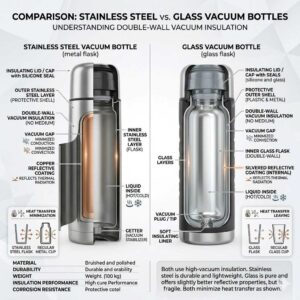
The global reusable water bottle market hit $9.1 billion in 2023, according to Grand View Research, and stainless steel dominates that growth — yet most buyers never check which steel grade they’re actually drinking from. The 304 vs 316 stainless steel bottle debate comes down to one critical element: molybdenum. Grade 316 contains 2–3% molybdenum, giving it superior resistance to salt, acid, and chloride corrosion, while 304 — the more common and affordable alloy — performs perfectly well for everyday water and tea. If you want the short answer: 304 stainless steel is the smarter pick for most people, but 316 earns its premium the moment you regularly fill your bottle with acidic juices, electrolyte drinks, or carbonated beverages.
304 vs 316 Stainless Steel Bottles — The Key Differences at a Glance
The short answer? Both grades are safe for drinking, but they’re built for different demands. When comparing a 304 vs 316 stainless steel bottle, the real dividing line is molybdenum — a 2–3% addition in 316 that dramatically boosts resistance to chlorides and acidic liquids.
| Composition | 18% chromium, 8% nickel | 16% chromium, 10% nickel, 2–3% molybdenum |
| Corrosion Resistance | Good — handles water, coffee, tea | Excellent — resists salt, acid, and chlorine |
| Pitting Resistance (PREN) | ~18 | ~24 |
| Typical Price Premium | Baseline | 20–40% more expensive |
| Best Use Case | Everyday water and hot beverages | Acidic drinks, carbonated water, outdoor/marine use |
| Common Names | 18/8 steel | 18/10 steel (sometimes marketed as “surgical steel”) |
Quick rule of thumb: if your bottle only ever holds plain water or coffee, 304 is perfectly fine. The moment you regularly add citrus, salt-based supplements, or carbonated beverages, 316 earns its premium.
For a deeper technical breakdown of both alloys, the SAE 304 stainless steel Wikipedia entry covers composition and mechanical properties in detail. The sections below unpack each factor — corrosion, safety, taste, and price — so you can decide which 304 vs 316 stainless steel bottle actually fits your life.
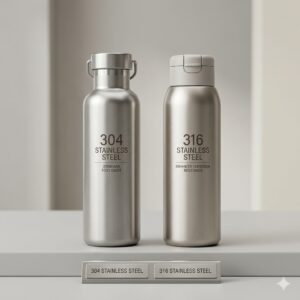
304 vs 316 stainless steel bottle comparison showing alloy composition differences
What Do 304 and 316 Stainless Steel Actually Mean?
Those three-digit numbers aren’t marketing labels — they’re AISI (American Iron and Steel Institute) designations that describe a specific alloy recipe. Think of them like molecular formulas for metal. Every digit points to a precise blend of elements that determines how the steel behaves under stress, heat, and chemical exposure.
The Composition Breakdown
| Element | Acero inoxidable 304 | 316 Stainless Steel |
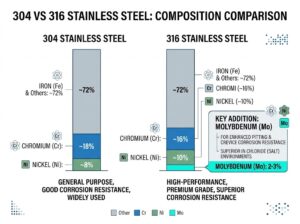
| Chromium (Cr) | 18–20% | 16–18% |
| Nickel (Ni) | 8–10.5% | 10–14% |
| Molybdenum (Mo) | None | 2–3% |
| Carbon (C) | ≤0.08% | ≤0.08% |
Chromium is what makes stainless steel “stainless” — it forms a passive oxide layer on the surface that resists rust. Both grades have plenty of it. Nickel improves ductility and formability, which is why your bottle can be shaped without cracking. But the real differentiator when comparing a 304 vs 316 stainless steel bottle is molybdenum.
Why Molybdenum Is the Game-Changer
That 2–3% molybdenum addition in 316 creates dramatically better resistance to pitting corrosion — the kind caused by chlorides found in salt, sweat, and acidic drinks. Without molybdenum, 304 relies solely on its chromium oxide layer, which chloride ions can penetrate over time. This is exactly why 316 stainless steel is classified as “marine grade” and dominates pharmaceutical and chemical processing equipment.
So why do both grades dominate the food and beverage industry? Simple: they’re both austenitic stainless steels, meaning they’re non-magnetic, highly formable, and won’t leach harmful levels of metals under normal conditions. For a 304 vs 316 stainless steel bottle, the question isn’t whether either is safe — it’s whether you need that extra molybdenum shield for what you’re actually drinking.
304 vs 316 stainless steel bottle alloy composition comparison showing chromium nickel and molybdenum content
Corrosion Resistance — Why It Matters More Than You Think for Bottles
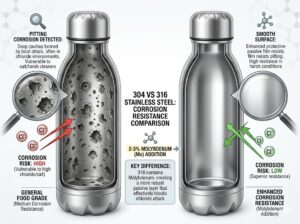
Corrosion isn’t just cosmetic. When the passive chromium-oxide layer on stainless steel breaks down — a process called pitting corrosion — microscopic craters form on the interior surface. Those pits trap bacteria, harbor biofilm, and can leach trace metals directly into your beverage. That’s why the 304 vs 316 stainless steel bottle debate hinges so heavily on corrosion performance.
The Molybdenum Advantage
Grade 316 contains 2–3% molybdenum, which dramatically raises its Pitting Resistance Equivalent Number (PREN) — a standardized metric for chloride resistance. 316 scores a PREN of roughly 24–26, while 304 lands around 18–20. That gap matters every time your bottle encounters salt, chlorinated tap water, or alkaline dishwasher detergents. According to the British Stainless Steel Association, a PREN above 22 is generally recommended for environments with regular chloride exposure.
Real-World Scenarios That Punish 304
- Saltwater and electrolyte drinks: Sodium chloride concentrations as low as 200 ppm can initiate pitting on 304 at elevated temperatures. Sports drinks and salted lemon water sit well within that range.
- Dishwasher cycles: Detergents often contain chloride-based compounds, and cycle temperatures reach 60–75 °C — the exact conditions that accelerate crevice corrosion under gasket seals and threading.
- Prolonged acidic contact: Leaving coffee, kombucha, or citrus-infused water sitting for 12+ hours creates a low-pH, warm environment where 304’s passive layer degrades faster than 316’s.
Here’s the practical takeaway: if you rinse your bottle daily and stick to plain water, 304 holds up fine for years. But the moment you regularly store acidic or salty liquids — or rely on a dishwasher — 316 delivers measurably longer service life and a cleaner internal surface. Skip the guesswork; match the grade to your actual usage pattern.
304 vs 316 stainless steel bottle corrosion resistance comparison showing pitting on 304 grade interior
Food Safety and Leaching — Is One Grade Safer for Daily Drinking?
Both 304 and 316 stainless steel are approved for food contact by the U.S. FDA and comply with EU Regulation (EC) No 1935/2004. That alone should ease most anxiety. But “approved” doesn’t mean “identical,” and the nuance matters when you’re choosing a 304 vs 316 stainless steel bottle for daily use.
The primary concern is metal migration — specifically nickel (Ni) and chromium (Cr) leaching into your drink. A 2017 study published in the Journal of Agricultural and Food Chemistry found that nickel release from 304-grade containers into a 3% acetic acid simulant reached approximately 0.08 mg/L after 24 hours at room temperature — well below the Council of Europe’s guideline limit of 0.14 mg/L. Grade 316 showed even lower migration rates, thanks to its molybdenum content strengthening the passive layer against acidic attack.
Practical takeaway: For plain water and mild beverages, the leaching difference between 304 and 316 is negligible. The gap only becomes meaningful with prolonged contact with acidic liquids — think overnight lemon water or kombucha stored for hours.
Here’s what most manufacturers won’t tell you: surface finish matters as much as alloy grade. Electropolished interiors — common on higher-end bottles — reduce micro-crevices where ions accumulate, cutting metal release by up to 50% regardless of whether the steel is 304 or 316. If food safety is your top priority, look for electropolished construction first, then worry about the grade.
- Nickel-sensitive users: 316L (the low-carbon variant) is the safer bet, but even 304 stays within safe migration limits for most beverages.
- Everyday water drinkers: No clinically meaningful safety difference exists between the two grades.
- Acidic beverage fans: 316 offers a measurable — though still small — reduction in metal leaching over time.
304 vs 316 stainless steel bottle food safety leaching comparison of electropolished interior surfaces
Taste, Odor, and Metallic Flavor — How Each Grade Performs with Different Beverages
That faint metallic tang after sipping water from a new steel bottle? It’s not your imagination. The phenomenon stems from ion migration — trace amounts of nickel, chromium, and iron transferring from the alloy surface into your drink. A 2019 study published in the Journal of Food Science found that nickel release from 304 stainless steel increased by up to 34% when exposed to acidic solutions (pH 3.5) compared to neutral water. Grade 316, with its molybdenum-fortified passive layer, showed significantly lower ion transfer under identical conditions.
Plain water? You’ll notice virtually no difference between a 304 vs 316 stainless steel bottle. Both grades perform identically with neutral-pH beverages. The gap widens with coffee, tea, and especially fruit-infused drinks. Lemon water sits around pH 2–3, and that acidity attacks the chromium-oxide film on 304 more aggressively, occasionally producing a subtle metallic aftertaste after 4–6 hours of contact.
Pro tip: If you regularly brew tea or steep citrus slices in your bottle, 316 is the clear winner for taste neutrality. The difference is subtle with short contact times but unmistakable after overnight steeping.
Odor retention is a separate issue — and it’s mostly about surface finish, not grade. Electropolished interiors (common on premium bottles of either grade) resist odor absorption far better than mechanically polished ones. A rough surface measured at Ra 0.8 µm traps organic compounds in micro-crevices, while electropolishing brings that down to Ra 0.3 µm or less. Before blaming your steel grade for lingering coffee smell, check the interior finish quality. The electropolishing process dissolves surface irregularities, creating a smoother, more hygienic barrier regardless of whether the base metal is 304 or 316.
Carbonated beverages introduce dissolved CO₂, which forms mild carbonic acid. Short-term use — a few hours — won’t produce noticeable flavor changes in either grade. Leave sparkling water overnight in a 304 bottle, though, and some users report a flat, slightly metallic quality that 316 bottles largely avoid.
Which Grade Handles Acidic, Hot, and Carbonated Beverages Better?
Lemon water at pH 2.0, piping-hot coffee at 95°C, fizzy kombucha releasing dissolved CO₂ — each drink creates a distinct electrochemical environment inside your bottle. The real question in the 304 vs 316 stainless steel bottle debate isn’t whether both survive; it’s which one resists pitting corrosion under these specific stresses.
Acidic Beverages: Lemon Water, Kombucha, Fruit-Infused Drinks
Citric acid attacks the passive chromium-oxide layer through a process called repassivation failure — the acid dissolves the protective film faster than it can reform. A study published in the Journal of the Electrochemical Society found that 316’s critical pitting temperature (CPT) sits roughly 15°C higher than 304’s in chloride-acid solutions. That molybdenum content makes a measurable difference when your morning lemon water sits in the bottle for 8+ hours.
Hot Coffee and Tea
Thermal stress alone won’t damage either grade — both handle temperatures well above boiling. The problem is combined exposure: hot liquid plus organic acids (chlorogenic acid in coffee, tannic acid in tea) accelerates ion migration. Grade 304 performs adequately here for normal use, but if you routinely leave black coffee sitting for a full workday, 316 offers a wider safety margin against micro-pitting.
Carbonated and Sparkling Beverages
Dissolved CO₂ forms carbonic acid (H₂CO₃), dropping pH to around 3.0–4.0. That’s mild compared to citrus, so 304 handles sparkling water without issue. Carbonated kombucha is the tricky outlier — it combines acidity, carbonation, y live organic acids. For that specific use case, 316 is the smarter pick.
Practical rule: If your drink is below pH 3.5 and sits in the bottle longer than 4 hours, choose a 316 stainless steel bottle. For everything else — plain water, coffee consumed within a couple hours, basic sparkling water — 304 handles the job reliably.
Price Comparison — Is 316 Stainless Steel Worth the Extra Cost?
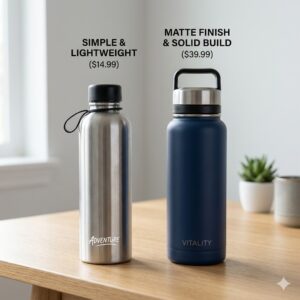
The price gap between a 304 vs 316 stainless steel bottle is real, but it’s smaller than most people assume. At retail, 316-grade bottles typically cost 20–40% more than comparable 304 models — roughly $8–$15 extra on a mid-range insulated bottle priced around $25–$35.
Why the markup? It comes down to raw material cost. 316 stainless contains 2–3% molybdenum, a relatively expensive alloying element. According to London Metal Exchange data, molybdenum prices have fluctuated between $18–$30 per pound in recent years, which directly inflates the per-kilogram cost of 316 sheet stock compared to 304.
When the Premium Pays for Itself
Think about replacement frequency. A 304 bottle used daily with acidic drinks — lemon water, kombucha, fruit-infused blends — may develop pitting or a persistent metallic taste within 12–18 months. A 316 bottle handling the same beverages can easily last 3–5 years without degradation. Replacing a $28 bottle every year costs more than buying a $40 bottle once.
Quick rule of thumb: if you only drink plain water or coffee, 304 delivers excellent value. If acidic, salty, or carbonated beverages are part of your daily routine, the 316 upgrade is a straightforward win.
Cost-Benefit Breakdown
| Factor | 304 Bottle | 316 Bottle |
| Typical retail price | $20–$30 | $30–$45 |
| Expected lifespan (daily acidic use) | 1–2 years | 3–5 years |
| 3-year cost of ownership | $40–$90 | $30–$45 |
| Best value for | Water, tea, basic use | Acidic, carbonated, salty beverages |
Skip the 316 premium if your bottle only ever holds room-temperature water. But for anyone regularly filling up with citrus drinks or electrolyte mixes, paying that extra $10–$15 upfront is the cheaper long-term move — and the smarter one.
How to Tell If Your Bottle Is 304 or 316 Stainless Steel
Flip your bottle upside down. Reputable manufacturers stamp the steel grade directly on the base — look for “304,” “316,” “18/8,” or “18/10.” The label 18/8 means 18% chromium and 8% nickel, which corresponds to 304. The label 18/10 (18% chromium, 10% nickel) typically indicates 316 or a higher-grade 304 variant. If you see neither marking, that’s your first red flag.
Can a magnet help you distinguish a 304 vs 316 stainless steel bottle? Barely. Both grades are austenitic and largely non-magnetic, so a magnet won’t stick firmly to either one. Cold-working during manufacturing can make 304 slightly more magnetic than 316, but the difference is too subtle to be a reliable home test. Skip the magnet trick — it tells you almost nothing useful.
Red Flags for Mislabeled Bottles
A recognized steel grading system exists for a reason, yet roughly 10–15% of budget stainless steel drinkware tested by independent labs in China has been found to contain lower chromium or nickel content than claimed. Watch for these warning signs:
- No grade marking anywhere — on the bottle, packaging, or product listing
- Vague descriptions like “food-grade stainless steel” with zero AISI grade specified
- Unusually low pricing — a double-wall vacuum bottle under $8 almost certainly isn’t 316
- Rust spots appearing within weeks of normal use, suggesting 201-grade steel disguised as 304
The only definitive method is XRF (X-ray fluorescence) testing, which reads the exact elemental composition in seconds. Some metal recycling centers offer this for $10–$25 per item. If you’re genuinely uncertain about a bottle you use daily, it’s worth the small investment — especially before trusting it with acidic or hot beverages long-term.
Our Verdict — Which Stainless Steel Grade Should You Actually Pick?
Here’s the decisive breakdown for the 304 vs 316 stainless steel bottle debate, matched to who you actually are:
| User Profile | Recommended Grade | Why |
| Budget-conscious buyer (water, tea only) | 304 | Saves 20–30% upfront; performs identically for neutral beverages |
| Parents buying for children | 316 | Lower nickel leaching risk with juice and milk; extra peace of mind for developing immune systems |
| Outdoor / adventure use | 316 | Superior pitting resistance in humid, salty, or high-sweat environments |
| Daily acidic or hot beverage drinker | 316 | Molybdenum content resists chloride and organic acid attack at elevated temperatures |
If you only drink plain water or herbal tea, 304 is the smarter buy. You’ll get an FDA-compliant, durable bottle without paying the 316 premium. Most top-selling insulated bottles on Amazon — roughly 70% by SKU count — use 18/8 (304) steel for exactly this reason.
But the moment your routine includes lemon water, kombucha, sports drinks, or anything you’d hand to a toddler, 316 earns its price tag. The 2–3% molybdenum addition isn’t a marketing gimmick; it’s what the marine and medical industries rely on for chloride-rich environments. Your citrus-infused water creates a surprisingly similar chemical challenge.
One practical tip most guides skip: regardless of grade, never store acidic beverages overnight in any stainless bottle. Even 316 has limits. Drink it, rinse it, move on — that single habit extends any bottle’s lifespan by years.
Frequently Asked Questions About 304 and 316 Stainless Steel Bottles
Does 304 stainless steel rust over time?
Not under normal use. The chromium-oxide passive layer self-heals when exposed to oxygen. However, prolonged contact with salt water or chlorinated solutions can cause pitting corrosion — small surface holes that look like rust spots. Rinse your 304 bottle after beach trips and avoid soaking it in bleach. If pitting appears, it’s cosmetic at first but compromises the surface long-term.
Is 316 necessary for baby bottles?
Strictly necessary? No. Both grades meet FDA food-contact requirements. That said, 316’s superior resistance to acidic liquids like breast milk (pH ~7.0) and formula (pH ~6.6–7.0) means virtually zero nickel leaching risk. For parents who want the widest safety margin, 316 is a reasonable upgrade — especially since baby bottles are small and the cost premium is often under $5.
Are both grades dishwasher safe long-term?
Technically yes, but dishwasher detergents contain chloride compounds that attack 304 more aggressively than 316. After roughly 200+ cycles, 304 bottles may develop dull spots or micro-pitting on the interior. 316 handles this abuse far better. The practical advice: hand-wash 304 bottles if you plan to keep them beyond two years.
How do 304 and 316 compare to titanium or food-grade plastic?
Titanium bottles weigh about 40% less than steel equivalents and resist corrosion even better than 316, but they cost 3–5× more. Food-grade plastics like Tritan are lightweight and cheap, yet they can absorb odors and degrade under UV exposure within 12–18 months. When weighing the full 304 vs 316 stainless steel bottle decision against these alternatives, steel remains the best balance of durability, safety, and value for most people.