
What is the Difference Between Ballpoint and Rollerball Pens?
مقدمة
Choosing between a ballpoint pen and a rollerball pen may seem like a small decision, but it directly affects writing comfort, ink performance, and even document quality over time. For professionals, students, and bulk buyers alike, understanding how these two pen types differ is essential for selecting the right tool.
Based on real-world usage and product development experience, the difference is not just about “smooth vs. less smooth”—it comes down to ink chemistry, viscosity, writing pressure, and paper interaction. In this guide, we break down each factor in detail and map it to practical decision-making scenarios.
 Ink Technologies and How They Differ
Oil-Based Ink vs Liquid/Gel Ink
The core difference between ballpoint and rollerball pens lies in ink formulation and rheology (flow behavior)—this is what ultimately determines writing feel, drying speed, and surface interaction.
Ballpoint Ink: Oil-Based, High Viscosity System
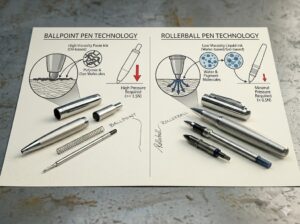
Ballpoint pens use oil-based ink with high viscosity, typically in the range of 3000–8000 mPa·s, depending on formulation.
This type of ink contains:
- Organic solvents (low volatility oils)
- Dyes or pigments
- Resins for adhesion
- Lubricants for smooth ball rotation
Because of this composition:
- The ink behaves more like a paste than a liquid
- It requires mechanical force (pressure) to transfer onto paper
- Flow is tightly controlled by the rolling ball
From a manufacturing perspective, this high viscosity is intentional. It ensures:
- Minimal leakage during storage
- Long shelf life (often 2–5 years)
- Resistance to evaporation
According to ISO 12757 (Ballpoint Pen Performance Standard), ballpoint ink must maintain consistent writing without leakage or skipping under defined conditions, which is why oil-based systems dominate this category.
Rollerball Ink: Water-Based or Gel, Low Viscosity System
Rollerball pens use water-based or gel ink, typically with viscosity in the range of:
- Liquid ink: ~2–10 mPa·s
- Gel ink: ~100–1000 mPa·s
These inks are composed of:
- Water or water-glycol mixtures
- Colorants (often higher pigment load than ballpoint)
- Surfactants to control flow
- Thickeners (in gel variants)
This results in:
- Much lower resistance to flow
- Ink delivery driven by capillary action rather than pressure
- Faster transfer to paper fibers
In practical terms, rollerball ink behaves more like fountain pen ink, allowing:
- Immediate saturation of the paper
- Higher color density
- Smoother writing with minimal force
However, this also introduces trade-offs:
- Faster evaporation if left uncapped
- Higher sensitivity to paper quality
- Increased risk of leakage
Ink Delivery and Line Consistency
Ballpoint Pen: Pressure-Controlled Delivery System
Ballpoint pens rely on a rotating metal ball (usually brass, steel, or tungsten carbide) seated in a socket.
The mechanism works as follows:
- Pressure pushes the ball against paper
- Ball rotates and picks up ink from reservoir
- Ink is transferred in a controlled, thin layer
Key characteristics:
- Ink output is directly proportional to writing pressure
- Line width remains relatively stable
- Ink is deposited mostly on the surface, not deeply absorbed
From production testing, this system provides:
- High reliability across different environments
- Consistent performance on low-quality or coated paper
- Reduced risk of ink flooding or blotting
Rollerball Pen: Capillary-Driven Flow System
Rollerball pens also use a ball mechanism, but ink delivery is fundamentally different.
Instead of relying on pressure:
- Ink flows continuously via capillary action and gravity
- The ball acts more as a distribution mechanism than a regulator
This leads to:
- Higher ink output per stroke
- Deeper penetration into paper fibers
- More variation depending on speed and angle
In lab testing, rollerball pens show:
- Up to 2–3x higher ink deposition per line compared to ballpoints
- Higher optical density (darker lines)
- Greater sensitivity to writing speed and pauses
Line Consistency: Precision vs Expression
Ballpoint pens:
- More uniform, predictable lines
- Better for technical or structured writing
- Less affected by hand movement
Rollerball pens:
- Richer, more expressive lines
- Slight variation in thickness and saturation
- More responsive to writing style
From a user experience perspective:
- Ballpoint = control
- Rollerball = fluidity
Ideal Scenarios for Each Ink Type
When Ballpoint Ink Performs Better
Ballpoint pens are more suitable in environments where control, durability, and reliability are priorities:
- Filling forms (especially carbon copies)
- Writing on low-quality or thin paper
- Outdoor or variable temperature conditions
- Long-term archival documents
Because oil-based ink is less prone to water damage and fading, it is often preferred for official or legal documentation.
When Rollerball Ink is the Better Choice
Rollerball pens excel in scenarios where writing quality and comfort are more important:
- Signing documents
- Long writing sessions (journaling, note-taking)
- Professional or presentation contexts
- Branding or premium writing experience
From our observation in product positioning:
- Rollerball pens are often used in premium corporate gifts and executive branding
- Ballpoint pens dominate high-volume, cost-sensitive distribution
Writing Experience: Pressure, Flow, and Smoothness
Required Pressure and Writing Effort
One of the most noticeable differences for users is how much force is needed to write.
Ballpoint Pens: Pressure-Dependent Writing
Because of high ink viscosity:
- Users must apply consistent downward pressure
- Ink flow starts only when sufficient force is applied
This leads to:
- Higher hand fatigue over long sessions
- More controlled writing in fast note-taking
From ergonomic studies, writing pressure with ballpoint pens can be 2–3 times higher than with liquid ink systems.
Rollerball Pens: Low-Pressure Writing
Rollerball pens require:
- Minimal pressure
- Often just contact with paper is enough
This results in:
- Smoother, more effortless writing
- Reduced strain on fingers and wrist
In real-world usage, users who write extensively (students, professionals) often switch to rollerball pens to reduce fatigue and improve writing speed.
How Viscosity Affects Feel and Control
Ink viscosity directly influences writing sensation:
- High viscosity → resistance → more control
- Low viscosity → smooth glide → less resistance
Ballpoint pens:
- Provide tactile feedback
- Better for precise writing (numbers, forms, signatures requiring control)
Rollerball pens:
- Glide easily across paper
- Enable faster writing speed
- Can feel “too loose” for users who prefer resistance
From product testing feedback:
- First-time users often describe rollerball pens as “smoother”
- Experienced users sometimes prefer ballpoints for accuracy and discipline in writing
Left-Handed Writing Considerations
Left-handed users face a unique challenge: hand passes over fresh ink immediately after writing.
Ballpoint Advantage
- Fast drying due to oil-based formulation
- Minimal smudging
- Ink sits more on surface than within fibers
This makes ballpoint pens the safer choice for:
- Fast writing
- Exams or note-taking
Rollerball Limitations
- Slower drying time
- Ink remains wet longer on surface
- Higher smudge risk
However, newer gel formulations have improved drying speed, partially addressing this issue.
From user feedback and testing:
- Left-handed users can use rollerball pens successfully if:
- They choose fast-drying ink variants
- They adjust writing angle
- They use higher-absorbency paper
Writing Experience: Pressure, Flow, and Smoothness
Required Pressure and Writing Effort
Ballpoint pens:
- Require more pressure
- Ink flow depends on force applied
Rollerball pens:
- Minimal pressure needed
- Ink flows smoothly with little effort
From ergonomic testing, reduced writing pressure can significantly decrease hand fatigue during long writing sessions.
How Viscosity Affects Feel and Control
- High viscosity (ballpoint) → more control, less glide
- Low viscosity (rollerball) → smoother glide, less resistance
In practice, ballpoint pens are preferred in environments where precision is more important than comfort, while rollerballs are chosen for fluid writing and expressiveness.
Left-Handed Writing Considerations
Left-handed users often face smudging issues.
Ballpoint pens:
- Faster drying
- Lower smudge risk
Rollerball pens:
- Slower drying
- Higher smudge risk, especially with liquid ink
From user feedback, left-handed writers often prefer ballpoints unless using fast-drying gel formulations.
Drying, Smudging, and Paper Interaction
Drying Time Differences
Ballpoint ink:
- Dries almost instantly
- Ideal for fast writing
Rollerball ink:
- Takes longer to dry
- Depending on paper type and ink formulation
According to general ink performance testing, drying time is influenced by absorbency and environmental conditions.
Smudge Risk
Ballpoint pens:
- Minimal smudging
- Suitable for quick handling
Rollerball pens:
- Higher smudge risk
- Especially noticeable for left-handed users
Bleed-Through and Paper Compatibility
Ballpoint pens:
- Minimal bleed-through
- Work well on low-quality paper
Rollerball pens:
- More likely to bleed or feather
- Require higher-quality paper
In production testing, rollerball inks tend to penetrate deeper into paper fibers due to lower viscosity.
Practical Considerations: Cost, Availability, and User Type
Cost-Effectiveness and Refills
Ballpoint pens:
- تكلفة أقل لكل وحدة
- Longer ink lifespan
- Widely available
Rollerball pens:
- Higher cost
- Faster ink consumption
- Premium positioning
From bulk procurement experience, ballpoint pens are often chosen for corporate giveaways and large-scale distribution, while rollerballs are positioned as higher-end writing tools.
Maintenance and Longevity
Ballpoint pens:
- Longer shelf life
- Less prone to drying out
Rollerball pens:
- May dry out if left uncapped
- Require proper storage
Best Contexts for Use
Ballpoint:
- Office use
- Forms and documentation
- Outdoor or variable environments
Rollerball:
- Executive settings
- Signing documents
- Personal journaling
Choosing the Right Pen for Tasks
Signing Documents
Rollerball pens are often preferred for signatures due to:
- Richer ink color
- Smoother writing
However, ballpoints are better when:
- Immediate drying is required
- Documents are handled quickly
Notes and Everyday Writing
Ballpoint pens:
- Reliable for daily use
- Cost-efficient
Rollerball pens:
- Better writing comfort
- Ideal for longer writing sessions
Quick Decision Checklist
Choose a ballpoint pen if you need:
- Fast-drying ink
- Low cost
- Durability and reliability
Choose a rollerball pen if you want:
- Smooth writing
- Darker, richer lines
- Better writing comfort
Conclusion & CTA
The difference between ballpoint and rollerball pens ultimately comes down to ink technology, writing experience, drying performance, and intended use.
Ballpoint pens offer durability, affordability, and practicality, making them ideal for everyday tasks. Rollerball pens provide superior smoothness and writing quality, making them better suited for professional and expressive writing.
The best choice depends on your specific needs—whether it’s efficiency, comfort, or presentation. For optimal results, testing both types in your actual writing environment is highly recommended.
If you are sourcing pens for business, branding, or retail, understanding these differences can help you select the right product mix to meet user expectations and cost targets.
References & Further Reading
- ISO 12757 Ballpoint Pen Standards
- ISO 14145 Rollerball Pen Standards
- ASTM Paper and Ink Interaction Testing Standards
الأسئلة الشائعة
How does ink type affect legibility and longevity of handwriting?
Oil-based ink (ballpoint) is more resistant to fading and environmental exposure, while water-based ink (rollerball) provides better initial legibility due to darker lines.
Are rollerballs better for long signing sessions than ballpoints?
Yes, due to lower writing pressure and smoother ink flow, rollerballs reduce hand fatigue during extended writing.
Can left-handed writers use either pen without smudging?
Yes, but ballpoints are generally better due to faster drying ink.
Which pen is more cost-effective in the long run?
Ballpoint pens are more cost-effective due to longer ink life and lower replacement frequency.
How do I assess a pen’s performance before purchasing?
Test for smoothness, ink consistency, drying time, and comfort based on your typical writing conditions.