Are All Stainless Steel Water Bottles BPA-Free? What Really Matters for Safety
Stainless steel water bottles are often marketed as a safer alternative to plastic. Many people choose them specifically to avoid BPA, a chemical commonly associated with certain plastics. Over time, this has led to a widespread assumption: if a water bottle is made of stainless steel, it must be BPA-free.
The reality is slightly more nuanced.
While stainless steel itself does not contain BPA, not every stainless steel water bottle is automatically BPA-free in every component. Understanding where BPA can appear—and where it cannot—helps you make an informed decision rather than relying on assumptions or labels alone.
This article breaks down what BPA is, whether it exists in stainless steel bottles, which parts matter most for safety, and how to confidently choose a BPA-free reusable water bottle.
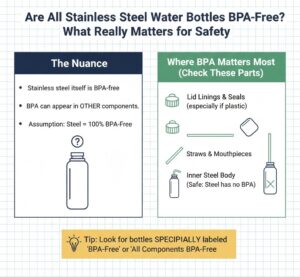
Key Takeaways
- Stainless steel as a material does nu contain BPA
- BPA concerns usually relate to plastic components, not the steel body
- Not all stainless steel water bottles are BPA-free as a complete product
- Bottle lids, straws, and seals matter more than the bottle body
- Understanding materials is more reliable than relying on labels alone
Do Stainless Steel Water Bottles Contain BPA?
This is the most common and direct question—and the answer depends on what part of the bottle you are referring to.
What BPA Is and Where It Is Usually Found
BPA, or bisphenol A, is a chemical compound used primarily in the production of certain plastics and resins. It has historically been found in:
- Some food and beverage containers
BPA is not a metal additive and is not used in the manufacturing of stainless steel.
Why Stainless Steel Itself Does Not Contain BPA
Stainless steel is an alloy made from iron, chromium, and other metals. Its structure and manufacturing process do not involve BPA or similar plastic-based chemicals.
As a result:
- The stainless steel bottle body itself does not contain BPA
- BPA cannot leach from solid stainless steel
- The metal surface remains stable under normal beverage use
If a bottle were made entirely from stainless steel with no other materials, BPA would not be a concern.
Is BPA Found in Stainless Steel?
This question often appears in search results because of confusion between materials şi products.
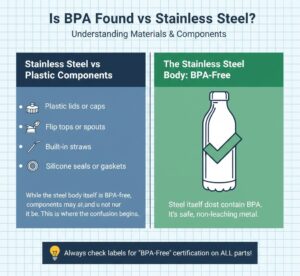
Stainless Steel vs Plastic Components
Most stainless steel water bottles are not made entirely of metal. Common non-metal components include:
- Plastic lids or caps
- Flip tops or spouts
- Built-in straws
- Silicone seals or gaskets
While the steel body itself is BPA-free, plastic components may or may not be, depending on how they are manufactured.
This is where the confusion begins.
Why Some Bottles Are Labeled “BPA-Free”
Many stainless steel bottles are labeled “BPA-free” not because the steel needs it, but because:
- Cel/Cea/Cei/Cele lid or internal plastic parts have been tested
- Consumers expect reassurance due to plastic alternatives
- Regulations and marketing practices favor clear labeling
In other words, the label usually applies to the whole product, not just the metal portion.
Are All Stainless Steel Water Bottles Safe?
Safety is a broader concept than BPA alone. While BPA avoidance is important for many consumers, it is not the only factor that determines whether a bottle is safe.
What “Safe” Means in This Context
When people ask if a bottle is safe, they usually mean:
- Is it suitable for food and beverage contact?
- Does it leach harmful substances?
- Can it be used daily without concern?
For stainless steel bottles, safety depends on materials, construction, and design, not just the absence of BPA.
Factors That Affect Overall Bottle Safety
Several elements influence how safe a stainless steel water bottle is in everyday use:
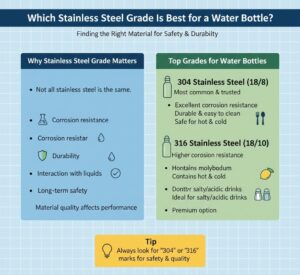
- Stainless steel grade (commonly food-grade options like 304 or 316)
- Quality of plastic parts, if any
- Presence of internal coatings or linings
- Manufacturing standards and compliance
A bottle can be BPA-free and still poorly designed if low-quality plastics or coatings are used.
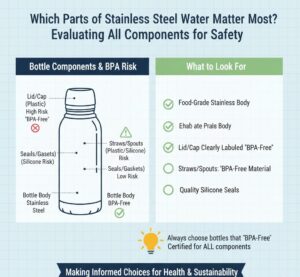
Which Parts of a Stainless Steel Water Bottle Matter Most?
To evaluate whether a stainless steel bottle is truly BPA-free and safe, it helps to break the product down into parts.
The Bottle Body
- Typically made from food-grade stainless steel
- Naturally BPA-free
- Does not require BPA-free labeling
The Lid or Cap
- Often made from plastic
- Most likely place for BPA concerns
- Should be clearly labeled BPA-free
Straws and Spouts
- Common in insulated or sports bottles
- Frequently made from plastic or silicone
- Material quality matters
Seals and Gaskets
- Usually silicone
- BPA is uncommon here, but quality still matters
Internal Coatings (If Present)
- Some bottles include coatings for insulation or taste neutrality
- These should be food-safe and clearly disclosed
What Water Bottles Do Not Contain BPA?
Understanding which materials are commonly BPA-free helps simplify decision-making.
Materials Commonly Considered BPA-Free
- Stainless steel
- Glass
These materials do not require BPA in their production and are widely used in reusable drinkware.
When BPA-Free Labels Matter Most
BPA-free labeling is especially important when dealing with:
- Plastic water bottles
- Plastic lids or internal components
- Mixed-material products
In stainless steel bottles, the label typically refers to non-metal parts.
How to Check If a Stainless Steel Water Bottle Is BPA-Free
Rather than assuming, consumers can verify BPA status with a few practical checks.
What to Look For
- Product descriptions specifying BPA-free components
- Material breakdowns for lids and straws
- Manufacturer compliance or safety statements
- Transparent information about coatings or linings
A lack of BPA-free labeling does not automatically mean a product contains BPA—but clear disclosure builds confidence.
Common Misunderstandings About BPA and Stainless Steel Bottles
Several misconceptions persist around BPA and stainless steel products.
- “All stainless steel bottles are automatically BPA-free” – True for the steel body, not always for the entire product
- “BPA-free means completely risk-free” – BPA is only one factor in product safety
- “If it’s not labeled BPA-free, it must contain BPA” – Not necessarily; labeling practices vary
Understanding these distinctions prevents unnecessary concern.
Final Answer: Are All Stainless Steel Water Bottles BPA-Free?
The most accurate answer is:
- Stainless steel as a material does not contain BPA
- The bottle body itself is BPA-free
- The overall product depends on the materials used in lids and accessories
In practice, most modern stainless steel water bottles are designed to be BPA-free across all components, but confirmation comes from understanding materials—not assumptions.
Frequently Asked Questions (FAQ)
Can BPA leach from stainless steel water bottles?
No. BPA cannot leach from stainless steel because it is not part of the material.
Is BPA-free labeling necessary for metal bottles?
It is mainly relevant for plastic components such as lids or straws, not the steel body.
Are stainless steel bottles safer than plastic ones?
Many people prefer stainless steel because it does not rely on plastic for the main structure, but overall safety depends on design and materials.
Do bottle lids contain BPA?
Some plastic lids may contain BPA unless specified otherwise. Many modern bottles use BPA-free plastics.
How can I choose a safe reusable water bottle?
Look for clear material information, food-grade stainless steel, BPA-free plastic components, and transparent manufacturer disclosures.