Can You Put Carbonated Drinks in a Stainless Steel Bottle?
Safety, Pressure Risks, and Brand-Specific Explanations
Reusable stainless steel bottles are everywhere—from gyms and offices to cars and classrooms. As people try to reduce single-use plastics, a common question keeps coming up:
Can you put carbonated drinks in a stainless steel bottle?
At first glance, it seems harmless. Stainless steel is strong, food-safe, and used for many beverages. But when carbonation is involved, the answer is not a simple yes or no. Issues like pressure buildup, lid design, and temperature changes all play a role.
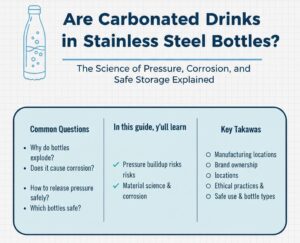
This article explains why carbonated drinks can be problematic in stainless steel bottles, why brands like Yeti and Stanley often advise against it, what actually happens inside the bottle, and how to reduce risks if you choose to do it anyway.
Why People Ask About Carbonated Drinks in Stainless Steel Bottles
Carbonated drinks are no longer limited to disposable soda cans or plastic bottles. In recent years, people have increasingly carried carbonated beverages in reusable containers as part of a more sustainable lifestyle. Common examples include sparkling water, soda, carbonated energy drinks, and flavored fizzy beverages that are marketed as healthier or more convenient alternatives to traditional soft drinks.
At the same time, stainless steel bottles have become popular precisely because they are engineered to solve problems that disposable containers cannot. Most aço inoxidável bottles are designed to be highly insulated, tightly sealed, durable, and leakproof. These features are ideal for still water, coffee, or tea—but they introduce unexpected complications when carbonation is involved.
 This creates a mismatch between what the drink needs e what the bottle is designed to do.
Carbonated beverages naturally release gas over time. Stainless steel bottles, however, are designed to prevent anything from escaping. When these two forces interact—carbonation constantly generating pressure and a bottle designed to trap it—users may experience fizzing, sudden spraying, leaking lids, or even bottles opening forcefully when twisted open.
Many users only encounter this problem after trying it themselves, which explains why questions about carbonated drinks and stainless steel bottles are so common. The confusion doesn’t come from poor bottle quality, but from misunderstanding how carbonation behaves in sealed environments.
To understand why this happens, it’s necessary to look at the science behind carbonation and pressure.
How Carbonation Works: The Science Behind the Risk
Carbonated drinks contain dissolved carbon dioxide (CO₂), which is added under pressure during manufacturing. Inside the original factory-sealed container, the gas remains dissolved because internal pressure is carefully controlled and balanced.
Once the drink is transferred into another container—especially a fully sealed stainless steel bottle—that balance begins to change.
Inside a sealed stainless steel bottle, several processes occur simultaneously:
- CO₂ slowly comes out of solution as the drink sits, especially if the liquid is disturbed or warmed
- Gas accumulates in the headspace, the small pocket of air between the liquid surface and the lid
- Temperature changes amplify pressure, because warmer liquids hold less dissolved gas
- Shaking or movement accelerates gas release, rapidly increasing internal pressure
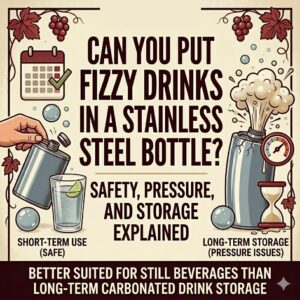
Unlike plastic soda bottles, stainless steel bottles are rigid. Plastic bottles are intentionally designed to flex and expand slightly under pressure, acting as a buffer. Stainless steel does not flex in a meaningful way. Instead, pressure is redirected to the weakest structural points: the lid, threads, gasket, and seals.
This means the better a stainless steel bottle is at sealing, the more effectively it traps pressure. Ironically, what makes the bottle excellent for leak prevention also makes it poorly suited for carbonated liquids.
Why Carbonated Drinks Can Be a Problem in Stainless Steel Bottles
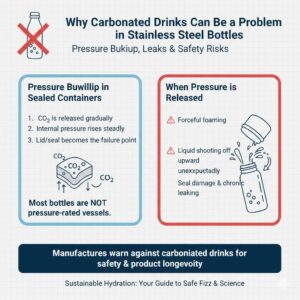
Pressure Buildup in Sealed Containers
Pressure buildup is the central issue when carbonated drinks are stored in stainless steel bottles.
When a carbonated beverage is placed into a sealed bottle:
- CO₂ continues to be released gradually from the liquid
- Internal pressure rises steadily, often without visible warning
- The stainless steel body remains structurally stable
- The lid, seal, or gasket becomes the failure point
Unlike factory soda containers, most stainless steel bottles are not pressure-rated vessels. They are designed to contain liquids, not gases under sustained pressure.
When the bottle is eventually opened, the accumulated pressure is released all at once. This sudden release can cause:
- Forceful foaming as gas rapidly escapes
- Liquid shooting upward toward the opening
- The lid popping off unexpectedly
- E-liquid spraying onto clothing, hands, or face
- Gradual seal damage that leads to chronic leaking later
This behavior is why manufacturers frequently warn users not to store carbonated beverages in their stainless steel bottles. These warnings are not about the stainless steel reacting with soda; they are about user safety, product longevity, and liability.
In short, the problem is not that the bottle “can’t hold soda,” but that it holds pressure too well.
Lid and Seal Design Limitations
Most stainless steel bottle lids are designed for:
- Water
- Still beverages
- Hot or cold non-carbonated liquids
They usually do not include pressure-release mechanisms. Common lid components that suffer under pressure include:
- Plastic threads
- Flip-top hinges
- Straw valves
Repeated exposure to pressure can:
- Deform seals
- Cause micro-leaks
- Reduce long-term leak resistance
The stainless steel body is rarely the problem—the lid system is.
Why Can’t You Put Carbonated Drinks in a Yeti?
Many people specifically ask: Why can’t you put carbonated drinks in a Yeti?
The answer lies in how Yeti bottles are designed.
Yeti bottles emphasize:
- Extremely tight sealing
- Strong insulation
- Leakproof performance
These features are excellent for water and hot drinks but work against carbonated beverages. A highly sealed environment traps CO₂, increasing internal pressure.
Yeti advises against carbonation primarily because:
- Opening under pressure can cause spraying
- Sudden release may surprise or injure users
- Pressure can damage lid components over time
This is a safety and liability issue—not a material safety issue.
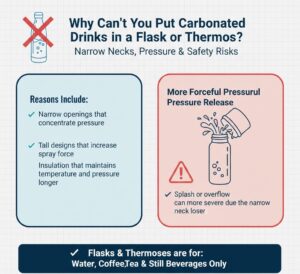
Why Can’t You Put Carbonated Drinks in a Flask or Thermos?
Flasks and thermoses are even more problematic for carbonation.
Reasons include:
- Narrow openings that concentrate pressure
- Tall designs that increase upward spray force
- Insulation that maintains temperature and pressure longer
In some cases, pressure release can be more forceful due to the narrow neck, making splashing or overflow more severe.
This is why most flasks are intended for:
- Water
- Coffee
- Tea
- Still beverages only
Is It Okay to Put Soda in a Stanley?
Stanley bottles are often mentioned because some models are not fully sealed.
Whether soda is “okay” depends on:
- Lid type
- Whether it uses a straw
- Whether gas can escape naturally
Some Stanley tumblers allow slight pressure release, which reduces risk. However:
- Stanley generally does not recommend carbonation for long-term storage
- Shaking or heat can still cause overflow
- Lids and straws are not pressure-rated
In practice:
- Short-term use may be manageable
- Long-term sealed storage is not advised
What Not to Put in a Stainless Steel Bottle
Carbonated drinks are not the only concern. Other liquids can also cause problems:
- Highly carbonated beverages (especially shaken)
- Fermenting drinks (kombucha, kefir)
- Dry ice or expanding substances
- Strong acids stored long-term
- Extremely hot liquids in bottles not rated for heat
These issues are less about stainless steel itself and more about pressure, corrosion over time, and seal degradation.
Does Carbonation Damage Stainless Steel Itself?
This is an important clarification.
Carbonated drinks do not typically damage stainless steel. High-quality stainless steel is resistant to:
- Mild acids
- Carbonic acid from CO₂
- Short-term beverage contact
The real risks are:
- Pressure buildup
- Lid failure
- User safety
In other words, the material is safe, but the use case may not be.
When Is It Relatively Safer to Put Carbonated Drinks in a Stainless Steel Bottle?
If someone chooses to do it anyway, risk can be reduced—but not eliminated.
Relatively safer conditions include:
- Leaving space at the top (do not fill completely)
- Using cold beverages only
- Avoiding shaking
- Opening slowly to release pressure
- Using lids that are not fully airtight
- Carrying for short periods only
Even under these conditions, manufacturers’ recommendations should take priority.
Practical Tips to Reduce Carbonation Risks
- Open the bottle slowly and away from your face
- Expect pressure even if the bottle hasn’t been shaken
- Avoid leaving carbonated drinks in hot environments
- Clean seals regularly to prevent deformation
- Replace damaged lids promptlyDica: If a bottle hisses when you open it, pressure has already built up.
Conclusion: Can You Put Carbonated Drinks in a Stainless Steel Bottle?
The short answer is: You can, but it’s not ideal—and often not recommended.
The key points are:
- Stainless steel itself is safe for carbonated drinks
- Pressure buildup is the real hazard
- Tightly sealed bottles increase risk
- Most manufacturers advise against it for safety reasons
If carbonation is important to you, the safest option is using bottles specifically designed and rated for carbonated beverages.
FAQ
Can you put carbonated drinks in a stainless steel bottle? Yes, but it is not recommended due to pressure buildup and safety concerns.
Why can’t you put carbonated drinks in a Yeti? Yeti bottles seal tightly, trapping CO₂ pressure that can cause spraying or lid damage.
Is it okay to put soda in a Stanley? Some Stanley models allow limited pressure release, but long-term storage is still discouraged.
Why can’t you put carbonated drinks in a flask? Narrow openings and strong insulation increase pressure release force and spill risk.
What drinks should never go in stainless steel bottles? Highly carbonated, fermenting, or expanding beverages should be avoided unless the bottle is specifically designed for them.