
Why Are They Called Owala?
Why Do People Ask “Why Are They Called Owala?
As consumer markets become increasingly crowded, brand names are no longer just labels — they are signals. For many buyers, a name is the first point of contact with a product, shaping expectations long before design, materials, or performance are evaluated.
In the case of Owala, the name stands out precisely because it does not behave like a traditional product name. It does not describe function, material, or category. Unlike legacy drinkware brands that emphasize durability, insulation, or technical performance through their names, “Owala” feels intentionally detached from utility.
This creates a subtle cognitive gap for consumers. When a name does not immediately explain what a product is or does, people naturally begin to ask why. The question “Why are they called Owala?” is less about linguistics and more about intent — people are trying to understand what the brand wants to represent.
Modern consumers, especially younger ones, are highly aware of branding strategies. They recognize when a name has been carefully constructed rather than organically descriptive. Owala’s name signals that it belongs to a category of lifestyle-driven brands where identity, emotion, and cultural alignment matter as much as function. That recognition is what drives curiosity.
In other words, people ask why Owala is called Owala because the name feels deliberate, not accidental — and deliberate branding invites interpretation.
What Does “Owala” Mean in English?
From a linguistic standpoint, “Owala” does not carry a direct meaning in English. It is not derived from a common noun, verb, or adjective, nor does it translate cleanly from another major language. This absence of literal meaning is not a weakness — it is a strategic choice.
Invented brand names have become increasingly common in global consumer markets because they offer flexibility. A word without a fixed definition allows a brand to build meaning over time, rather than inherit associations that may not align with its identity. Instead of explaining what the product is, the name becomes a container for the experience, values, and emotions the brand wants to project.
Phonetically, “Owala” is simple, soft, and rhythmic. It avoids harsh consonants or technical sounds, which makes it feel approachable and non-intimidating. The repetition of open vowel sounds gives it a relaxed tone, aligning well with everyday use and habitual behavior — qualities that are especially important for products integrated into daily routines, such as drinking water.
Crucially, because “Owala” is not tied to a specific function or material, it can evolve with the brand. It does not limit the company to a single product category, nor does it lock consumer perception into a narrow definition. This linguistic openness supports long-term brand scalability and cultural relevance.
Rather than asking what “Owala” means in a dictionary sense, it is more accurate to ask what the brand allows the name to mean through use, design, and cultural presence. In modern branding, meaning is no longer assigned — it is accumulated.
What Does “Owala” Mean in English?
Is “Owala” a Real English Word?
No. “Owala” is not a word found in standard English dictionaries. It is a brand-created name, intentionally invented rather than borrowed from an existing language.
This approach is extremely common among modern consumer brands, especially those targeting global and younger audiences.
Why Brands Create Invented Names
There are several strategic reasons companies choose invented names like Owala:
- Trademark flexibility Invented words are easier to trademark and protect globally.
- No pre-existing meaning Without a dictionary definition, the brand can shape its own identity.
- Global friendliness A made-up word avoids cultural or linguistic conflicts across markets.
- Emotional over literal appeal The name is designed to feel right rather than explain the product.
“Owala” is short, rhythmic, and easy to pronounce. It does not intimidate, sound technical, or feel corporate—qualities that matter greatly in lifestyle branding.
Why Are They Called Owala? (The Branding Logic)
Branding Over Literal Meaning
Owala’s name is not meant to describe what the product does. Instead, it is meant to reflect how the product fits into daily life.
The brand positions its bottles as:
- Casual
- Friendly
- Everyday companions
- Non-judgmental wellness tools
The name “Owala” feels playful and light, aligning with the idea of drinking water being an easy, natural habit rather than a strict health obligation.
How the Name Fits the Product Experience
Owala bottles are designed to be:
- Grab-and-go
- Easy to use
- Visually expressive
A short, upbeat name complements that experience. Compared to rigid, functional-sounding names, “Owala” feels personal and approachable, which encourages emotional attachment.
This is especially important in a product category where many options perform similarly at a technical level.
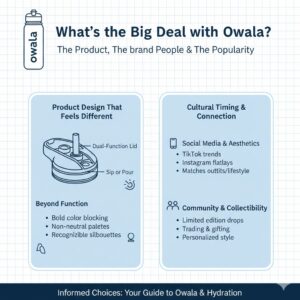
What’s the Big Deal with Owala?
Owala’s popularity is not accidental. It results from a combination of design decisions, cultural timing, and social behavior.
Product Design That Feels Different
One of Owala’s most talked-about features is its dual-function lid, allowing users to sip through a straw or tilt to pour—without switching lids.
Beyond function, Owala emphasizes:
- Bold color blocking
- Non-neutral palettes
- Recognizable silhouettes
These design choices make Owala bottles instantly identifiable, even in photos or videos.
Visual Culture and Social Media
Owala thrives in a visual-first environment:
- TikTok “hydration check” videos
- Instagram desk and gym aesthetics
- Lifestyle vlogs
The bottle becomes part of the scene, not just an accessory. Its appearance contributes to personal branding, which is especially important for younger users who document daily routines online.
Emotional Value Over Pure Utility
Owala bottles are not purchased only for hydration. They are often bought as:
- A small act of self-care
- A lifestyle upgrade
- A visible commitment to health habits
The emotional return matters as much as physical function.
Why Is Gen Z So Obsessed with Water Bottles?
Owala’s rise cannot be separated from broader generational trends.
Hydration as Self-Care
For Gen Z, hydration is closely linked to:
- Mental health
- Energy levels
- Skin care
- Productivity
Drinking water is no longer passive—it is a conscious wellness behavior.
Identity and Aesthetic Expression
Water bottles have become:
- Fashion-adjacent items
- Customizable objects (stickers, colors)
- Reflections of personality
Just like phone cases or tote bags, bottles are now part of daily visual identity.
Sustainability and Values
Reusable bottles symbolize:
- Environmental awareness
- Rejection of single-use plastics
- Ethical consumer behavior
Even when not perfect, reusable products represent alignment with long-term values.
Why Can’t You Put Hot Liquid in an Owala Water Bottle?
This is a common and important question.
The Issue Is the Lid Design, Not the Steel
While stainless steel itself can handle high temperatures, Owala bottles are designed primarily for cold and room-temperature beverages.
The lid and straw system:
- Is optimized for sipping
- Is not pressure-rated for hot liquids
- May allow heat expansion that causes leaks or splashes
Safety Considerations
Hot liquids introduce risks such as:
- Unexpected leakage
- Burn hazards
For this reason, Owala advises against using their bottles for hot drinks, prioritizing user safety over versatility.
Design Trade-Offs
Owala focuses on:
- Convenience
- Cold beverage use
- Daily hydration habits
Hot-drink compatibility was not the primary design goal.
How the Name “Owala” Supports Its Cultural Appeal
The name “Owala” works because it:
- Sounds informal
- Feels friendly
- Fits social media language
- Avoids sounding medical or technical
In short-form content, the name is easy to say, remember, and hashtag—an underrated but powerful branding advantage.
Common Misconceptions About Owala
- The name is not an acronym
- It does not stand for a phrase
- It is not borrowed from another language
- Popularity is driven by design and culture, not just hype
Conclusion: Why the Name “Owala” Makes Sense
“Owala” does not mean something in English—and that is precisely the point.
The name succeeds because it:
- Avoids rigid definitions
- Allows emotional branding
- Matches modern lifestyle values
- Resonates with Gen Z’s approach to wellness and identity
In a market where function alone is no longer enough, Owala demonstrates how naming, design, and culture intersect to create a powerful consumer brand.
FAQ
What does Owala mean in English? It does not have a dictionary meaning. Owala is an invented brand name.
Why are they called Owala? The name was created to feel friendly, modern, and lifestyle-oriented rather than descriptive.
Why is Owala so popular with Gen Z? Because it combines hydration, aesthetics, social media visibility, and sustainability values.
What’s the big deal with Owala bottles? Their design, color choices, and emotional appeal make them stand out beyond basic function.
Why can’t you put hot liquid in an Owala bottle? The lid and straw system are not designed for hot beverages, making it a safety issue rather than a material limitation.