Where Are Owalas Made?
Manufacturing Locations, Authenticity, Ethics, and Brand Ownership Explained
Reusable drink bottles have become a daily essential, and Owala has quickly grown into one of the most recognizable brands in this space. As its popularity increases, so do consumer questions—not just about design and performance, but about where Owala bottles are made, who owns the brand, whether they are ethically produced, and how to avoid counterfeit products.
This article provides a clear, fact-based explanation of those questions, helping consumers make informed decisions without marketing hype or misinformation.
Why People Ask “Where Are Owalas Made?”
In recent years, buyers have become far more aware of product origin. Many people actively look for items made in the United States, while others want reassurance that overseas manufacturing still meets safety and ethical standards.
With Owala, common questions include:
- Are Owalas made in the USA?
- What country owns Owala?
- Are Owala bottles ethically made?
- How can I tell if an Owala bottle is real or fake?
Understanding these concerns requires separating brand identity, design location, and manufacturing location, which are often confused.
What Country Owns Owala?
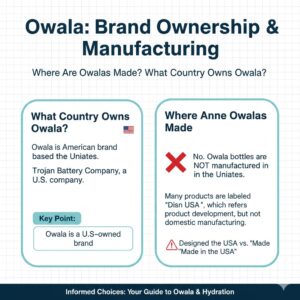
Owala is an American brand. The company is based in the United States, where product design, branding, and business operations are managed.
Owala is part of Trojan Battery Company, a long-established U.S. company with decades of experience in consumer and industrial products. While Trojan is best known for battery technology, its ownership of Owala reflects a broader consumer-products portfolio rather than a shift away from its core expertise.
The key point is this: Owala is a U.S.-owned brand, even though its products are not manufactured in the United States.
Where Are Owalas Made?
Are Owalas Made in the USA?
No. Owala bottles are not manufactured in the United States.
Many Owala products are labeled “Designed in the USA,” which refers to product development, engineering, and design decisions. This wording is common in consumer goods but does not indicate domestic manufacturing.
This distinction is important because “Designed in the USA” and “Made in the USA” are not the same thing under U.S. labeling standards.
 Actual Manufacturing Locations
Owala bottles are primarily manufactured in Asia, most commonly in China, where the majority of the global stainless steel drinkware industry operates.
This is not unusual. In fact, most major reusable bottle brands—across a wide range of price points—rely on overseas manufacturing for stainless steel products.
Reasons include:
- Specialized stainless steel forming and vacuum insulation expertise
- Large-scale production capacity
- Established quality-control infrastructure
- Cost efficiency that keeps retail prices accessible
Manufacturing location alone does not determine quality or safety.
Is This Normal for Premium Drinkware Brands?
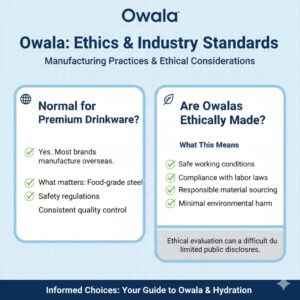
Yes. Even brands positioned as premium or lifestyle-focused typically manufacture overseas.
What matters more than where a bottle is made is:
- Whether food-grade stainless steel is used
- Whether products meet food-contact safety regulations
- Whether quality control is consistent
Owala follows the same global manufacturing model used by most well-known drinkware brands.
Are Owalas Ethically Made?
What “Ethically Made” Means in Drinkware
When consumers ask whether a product is ethically made, they usually mean:
- Safe working conditions
- Compliance with labor laws
- Responsible material sourcing
- Minimal environmental harm
Unlike clothing or electronics, drinkware manufacturing does not always come with detailed public supply-chain disclosures, which can make ethical evaluation difficult.
Owala’s Public Position on Ethics and Safety
Owala states that its bottles use:
- Food-grade stainless steel
- BPA-free plastic components (for lids and straws)
- Materials compliant with food-contact safety standards
There are no major public controversies or regulatory actions related to unsafe materials or unethical production practices associated with Owala.
What Owala Does Not Publicly Disclose
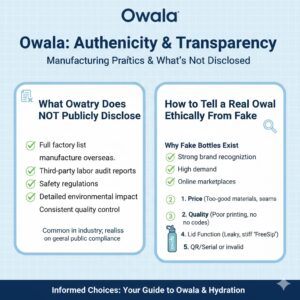
Like many consumer brands, Owala does not publish:
- A full factory list
- Third-party labor audit reports
- Detailed environmental impact assessments
This lack of disclosure is common in the industry and does not necessarily indicate unethical practices—but it does mean consumers must rely on general compliance standards rather than detailed transparency reports.
How to Tell a Real Owala from a Fake
As Owala’s popularity has grown, counterfeit products have appeared online. Knowing how to identify authentic products is increasingly important.
Why Fake Owala Bottles Exist
- Strong brand recognition
- Social media exposure
- High demand
- Online marketplaces with limited enforcement
Fake bottles often look convincing at first glance but differ in quality and safety.
Signs of an Authentic Owala Bottle
A genuine Owala bottle typically includes:
- High-quality packaging with clear printing
- Consistent branding and logo placement
- Solid construction with smooth edges
- Secure lid fit and reliable sealing
- No strong plastic or chemical odors
Purchasing through official retailers or the brand’s website greatly reduces risk.
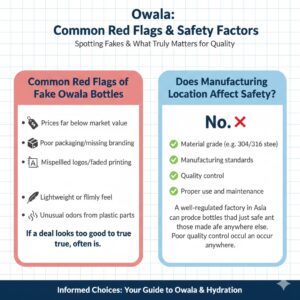
Common Red Flags of Fake Owala Bottles
- Prices far below typical market value
- Poor packaging or missing branding
- Misspelled logos or faded printing
- Lightweight or flimsy feel
- Unusual odors from plastic parts
If a deal looks too good to be true, it often is.
Does Manufacturing Location Affect Safety or Quality?
Not directly.
Stainless steel drinkware safety depends primarily on:
- Material grade
- Manufacturing standards
- 품질 관리
- Proper use and maintenance
A well-regulated factory in Asia can produce bottles that are just as safe and durable as those made anywhere else. Conversely, poor quality control can occur in any country.
For consumers, material labeling, brand accountability, and user reviews are far more reliable indicators of quality than country of origin alone.
What Consumers Should Really Look For
Instead of focusing solely on where a bottle is made, consumers should consider:
- Is the stainless steel food-grade?
- Are plastic parts BPA 없음?
- Is the brand established and accountable?
- Are there consistent reviews regarding durability and safety?
These factors have a greater impact on real-world safety than the manufacturing country itself.
Conclusion: Where Are Owalas Made—and Does It Matter?
Owala is a U.S.-owned brand with products manufactured overseas, primarily in Asia. This manufacturing model is standard across the stainless steel drinkware industry.
There is no evidence that Owala bottles are unsafe or improperly made when used as intended. While the brand does not provide extensive public supply-chain disclosures, it aligns with common industry practices regarding materials and safety standards.
For most consumers, the more important considerations are material quality, proper use, and purchasing from legitimate sources, rather than the specific country of manufacture.
FAQ
Where are Owalas made? Owala bottles are primarily manufactured in Asia, most commonly in China.
Are Owalas made in the USA? No. Owala bottles are designed in the USA but not manufactured there.
What country owns Owala? Owala is owned by a U.S.-based company.
Are Owala bottles ethically made? There is no public evidence of unethical practices, but detailed supply-chain disclosures are limited.
How can I tell if my Owala is fake? Check packaging quality, branding consistency, construction details, and buy from authorized sellers.
Does “Made in China” mean lower quality? Not necessarily. Quality depends on materials and quality control, not location alone.