
Where Did the Name Owala Come From?
Brand Origin, Cultural Meaning, and Why Gen Z Is Obsessed
Key Takeaways
- “Owala” is a coined brand name, not a dictionary word, created for memorability, sound, and emotional appeal rather than literal meaning.
- The name plays a major role in Owala’s popularity, especially among Gen Z, because it feels friendly, playful, and easy to say.
- Owala’s brand success is not just about bottles, but about how naming, design, and social media culture work together.
- Gen Z’s obsession with water bottles reflects identity, aesthetics, and lifestyle signaling, not just hydration.
- What makes Owala special is the alignment between its name, visual identity, and product design, creating a brand that feels modern and expressive rather than purely functional.
Why People Are Curious About the Name “Owala”
Brand names matter more today than ever before. Consumers no longer choose products solely based on function or price—they also care about how a brand sounds, feels, and fits into their identity. This shift is especially visible in lifestyle products like reusable water bottles.
As オワラ gained rapid popularity, many people began asking a simple but revealing question: Where did the name “Owala” come from?
The curiosity isn’t accidental. “Owala” doesn’t sound like a traditional product name. It doesn’t describe steel, insulation, or hydration. Instead, it feels playful, modern, and slightly mysterious—exactly the kind of name that sparks conversation.
Understanding the origin of the name helps explain not only the brand itself, but also why Gen Z has embraced Owala so enthusiastically.

What Is the Company Owala About?
To understand the name, it’s important to understand the brand philosophy behind it.
Owala positions itself as a functional lifestyle brand, not an outdoor gear company or a purely technical hydration product. While many water bottle brands emphasize ruggedness, endurance, or extreme environments, Owala focuses on everyday use—school, work, commuting, fitness, and social life.
Key aspects of the Owala brand include:
- Practical hydration features
- Bright, playful color combinations
- User-friendly design
- A casual, approachable tone
This positioning matters because brand names rarely exist in isolation. They are chosen to support a broader identity, and Owala’s identity is intentionally light, friendly, and expressive.
Where Did the Name “Owala” Come From?
A Coined Name, Not a Dictionary Word
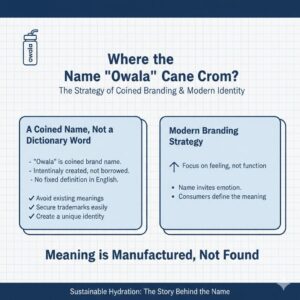
“Owala” is a coined brand name, meaning it was intentionally created rather than borrowed from an existing language or word. It does not have a fixed definition in English or another major language.
This approach is common in modern branding. Coined names allow companies to:
- Avoid existing meanings or limitations
- Secure trademarks more easily
- Create a unique brand identity from scratch
Instead of telling consumers what the product does, a coined name invites them to feel something first.
Why Sound and Rhythm Matter
One of the most important reasons “Owala” works is its sound.
Phonetically, the name:
- Uses open vowel sounds
- Has a smooth, flowing rhythm
- Is easy to pronounce across languages
- Feels informal and friendly
There are no harsh consonants or technical syllables. This makes the name easy to say out loud, easy to remember, and easy to share—especially in casual conversation or on social media.
In branding psychology, names like this tend to feel:
- Approachable
- Youthful
- Non-intimidating
These qualities align perfectly with Owala’s target audience.
What Does “Owala” Mean in English? (A Deeper Explanation)
“Owala” doesn’t have a fixed dictionary meaning in English, and that’s exactly the point. In modern branding, a name doesn’t always function like a word—it often functions like a sound-logo: a short, memorable signal that can carry identity without needing literal definition.
1) Why brands intentionally choose “meaningless” names
If a brand picks a descriptive name (like “Hydro,” “Thermo,” or “Flask”), it gains instant clarity—but it also inherits limitations:
- It can feel generic in a crowded category
- It ties the brand’s identity tightly to one product function
- It’s harder to trademark globally because many similar terms already exist
- It can trigger strong preconceptions (“this is outdoorsy,” “this is technical,” “this is premium,” etc.)
A coined name like “Owala” avoids these constraints. Because it doesn’t come with a built-in definition, the brand can build meaning over time through design, tone, user experience, and community behavior.
In other words, the meaning doesn’t come from a dictionary—it comes from repetition + association.
2) The phonetic “feel” of the name is the message
Even without literal meaning, names still communicate through sound. “Owala” has several characteristics that make it culturally “friendly”:
- Open vowel sounds that feel soft and approachable
- あ rhythmic, bouncy cadence that’s easy to say quickly
- No harsh consonants that would make it feel technical or industrial
- A short length that reduces friction in casual speech
This matters because in consumer psychology, people often decide whether something feels “for them” before they evaluate specs. A name that is easy to pronounce and slightly playful can quietly signal:
- low intimidation
- everyday ease
- lifestyle alignment
- a “fun” brand personality
3) A name without meaning invites consumer participation
Z世代 especially tends to like brands that feel open-ended and “co-created.” When the name doesn’t spell everything out, users do what people naturally do: they interpret it, joke about it, ask questions, and repeat it.
That curiosity loop is valuable. It turns a brand name into a conversation topic rather than a label.
So when someone asks “What does Owala mean in English?” the best answer is:
- It doesn’t translate literally
- It was designed to be memorable and brandable
- The brand experience creates the meaning
Over time, “Owala” becomes shorthand for a cluster of associations—color, design identity, convenience, and the kind of lifestyle content people attach to it. That’s meaning in the branding sense: not definition, but recognition.

Why Is Owala Suddenly So Popular? (Beyond “It Went Viral”)
Owala’s rise isn’t just “luck” or “TikTok hype.” It’s a predictable outcome when product design, brand identity, and cultural timing align. The popularity spike usually happens when a brand becomes more than useful—it becomes socially legible: people can recognize it, talk about it, and display it.
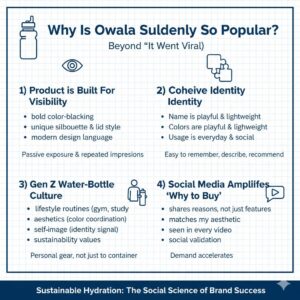
1) The product is built for visibility, not just function
Many bottles are good at keeping water cold. That alone doesn’t create cultural momentum. Owala’s key advantage is that its design is instantly recognizable at a glance, even in a crowded visual feed.
This comes from:
- bold color-blocking that pops on camera
- a silhouette and lid style that looks “different” on desks and in backpacks
- an overall design language that feels modern rather than “rugged gear”
When a product is recognizable in photos, it becomes easier for users to feature it unintentionally—sitting in the background of a study setup, gym mirror shot, or “what’s in my bag” video. That creates passive exposure and repeated impressions, which is exactly how “sudden” popularity forms.
2) The name + look creates a cohesive identity (and that coherence scales fast)
A major reason Owala spreads efficiently is that the name matches the product personality.
- The name feels playful and lightweight
- The colors feel playful and lightweight
- The usage context is everyday and social
This coherence matters more than many people realize. Brands that feel consistent are easier to remember, easier to describe, and easier to recommend. Consumers don’t need technical language to talk about it—they can simply say, “It’s the cute colorful one,” and people know what they mean.
3) Gen Z water-bottle culture turns “hydration” into an identity signal
Owala benefits from a broader cultural shift: water bottles became “personal gear,” not just containers.
For Gen Z, a water bottle can signal:
- lifestyle routines (gym, study, wellness)
- aesthetics (color coordination, desk setup culture)
- self-image (“I’m organized,” “I’m health-minded,” “I’m that kind of person”)
- sustainability values (reusables over disposables)
Once a product fits into identity signaling, it’s no longer competing only on performance—it’s competing as a personal accessory.
4) Social media doesn’t just spread the brand—it spreads the “reason to buy”
Platforms like TikTok and Instagram don’t work like traditional ads. People don’t share “features”—they share reasons, like:
- “This is the bottle everyone is getting”
- “This matches my aesthetic”
- “This is the one I see in every video”
- “This is the bottle that feels different from Stanley/Yeti”
That’s why popularity can feel sudden. Once a critical mass forms, the brand becomes socially validated, and demand accelerates through “I want what people like me use.”
So Owala’s popularity isn’t just about being a good bottle—it’s about being a bottle that fits the current cultural language of everyday lifestyle, aesthetics, and social proof.
Why Is Gen Z So Obsessed With Water Bottles?
At first glance, the idea of being “obsessed” with a water bottle seems strange. But for Gen Z, water bottles serve purposes beyond hydration.
They function as:
- Personal accessories
- Aesthetic objects
- Signals of lifestyle and values
Gen Z consumers tend to value:
- Visual expression
- Everyday items that feel personal
- Products that are both useful and expressive
A water bottle is something they carry everywhere, place on desks, bring into classrooms, and include in social content. Brands like Owala fit naturally into this behavior.
What’s Special About an Owala?
Owala’s appeal comes from the combination of elements, not any single feature.
What stands out:
- A distinctive multi-function lid
- Bright, unexpected color pairings
- A name that feels friendly rather than technical
- A brand voice that avoids extreme claims
Together, these elements create a product that feels designed for people, not environments.
The name “Owala” supports this by avoiding words associated with toughness, performance, or endurance. Instead, it reinforces everyday usability and approachability.
Naming Strategy: Why “Owala” Works as a Modern Brand Name
From a branding perspective, “Owala” checks many boxes:
- Non-descriptive (allows expansion beyond bottles)
- Easy to pronounce globally
- Memorable and distinct
- Emotionally neutral but adaptable
This makes the brand flexible. It can evolve into new product categories without being limited by a functional name like “Hydro” or “Flask.”
Common Misconceptions About the Name Owala
- It is not an acronym.
- It does not translate directly from another language.
- It is not tied to a technical feature.
The name was chosen to support branding, not to explain function.
Conclusion: Why the Name Owala Matters
The name “Owala” reflects a broader shift in consumer culture. Products today are not judged solely by performance, but by how they fit into daily life and personal identity.
By choosing a name that is:
- Playful
- Memorable
- Emotionally open-ended
Owala created a brand that feels accessible and expressive. Combined with thoughtful design and strong social presence, the name helped transform a simple water bottle into a recognizable lifestyle product—especially for Gen Z.
FAQ
Where did the name Owala come from? Owala is a coined brand name created for sound, memorability, and branding flexibility.
What does Owala mean? It does not have a literal meaning in English; its meaning comes from brand experience.
Why is Owala suddenly so popular? A mix of social media exposure, distinctive design, and Gen Z-friendly branding.
What is special about Owala bottles? They combine functional design with expressive aesthetics and a relatable brand identity.
Why do Gen Z consumers love water bottles so much? Water bottles serve as lifestyle accessories and visual expressions, not just hydration tools.