Can You Recycle Stainless Steel Water Bottles?
How Recycling Really Works, What to Do With Old Bottles, and Common Mistakes to Avoid
Reusable stainless steel water bottles are often marketed as an environmentally friendly alternative to single-use plastic. But when a bottle becomes dented, broken, outdated, or simply no longer used, many people are unsure what to do next. Questions like “Can stainless steel go in the recycle bin?” or “How do I dispose of an old metal water bottle?” are far more complex than they appear.
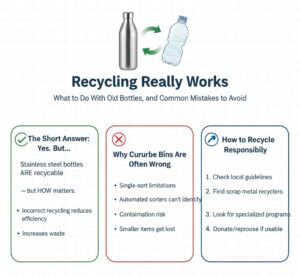
The short answer is yes, stainless steel water bottles are recyclable—but the how matters just as much as the what. Recycling stainless steel incorrectly can actually reduce recycling efficiency and increase waste. This article explains how stainless steel recycling works in practice, why curbside bins are often the wrong choice, and how to dispose of old or broken bottles responsibly.
Key Takeaways
- Stainless steel bottles are 100% recyclable as a material, but usually not curbside recyclable
- Scrap metal recycling facilities are the best and most reliable option
- Broken bottles should not be reused for drinking but remain valuable for recycling
- Removing plastic and silicone parts significantly improves recycling success
- Proper disposal reduces energy use, mining demand, and environmental impact
Understanding Stainless Steel: Why It’s Different From Other Materials
To recycle stainless steel correctly, it helps to understand what it is.
Stainless steel is an alloy made primarily from iron, combined with chromium and sometimes nickel. Chromium is what gives stainless steel its corrosion resistance, while nickel improves durability and temperature stability. These properties make stainless steel ideal for food and beverage containers—but they also make it valuable in recycling markets.
From an environmental standpoint, stainless steel has three major advantages:
- It does not degrade when recycled Unlike many plastics, stainless steel can be melted and reused repeatedly without losing strength or quality.
- It has high scrap value Stainless steel is actively traded in global scrap markets, which means it is unlikely to be ignored or discarded when processed correctly.
- It supports closed-loop recycling Old stainless steel products can become new stainless steel products, rather than being “downcycled” into lower-grade materials.
This is why stainless steel bottles should never be treated as ordinary trash.
Are Stainless Steel Water Bottles Recyclable?
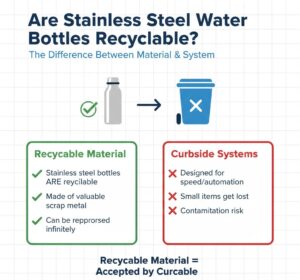
Yes—stainless steel water bottles are recyclable from a materials science perspective. However, recyclability does not automatically mean they belong in household recycling bins.
This is one of the most common misunderstandings in consumer recycling.
Recyclable material ≠ accepted by curbside recycling systems
Municipal recycling programs are designed around speed, automation, and cost efficiency—not around processing every recyclable object.
Can Stainless Steel Go in the Recycle Bin?
In most cities, stainless steel water bottles should NOT be placed in curbside recycling bins.
Why Curbside Recycling Often Rejects Them
- Sorting equipment limitations Most recycling facilities are optimized for flat or lightweight items such as aluminum cans, plastic bottles, and paper. A rigid stainless steel bottle can jam conveyor belts or be misidentified by automated sorters.
- Multi-material construction Most bottles include:
- Plastic lids
- Silicone seals
- Rubber gaskets
- Powder-coated finishes
These mixed materials confuse sorting systems and increase contamination risk.
- Contamination penalties When non-processable items enter recycling streams, entire batches may be downgraded or diverted to landfill. This is why recycling programs discourage “wish-cycling.”
Are There Exceptions?
Some municipalities accept small metal items beyond cans, but this is not standard practice. Always check local recycling guidelines before placing a stainless steel bottle in a bin.
The Correct Way to Recycle a Stainless Steel Water Bottle
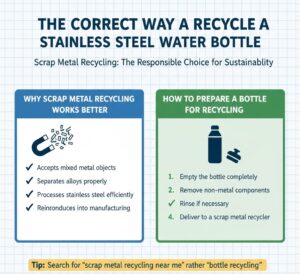
The most effective and environmentally responsible option is scrap metal recycling.
Why Scrap Metal Recycling Works Better
Scrap metal facilities are specifically designed to:
- Accept mixed metal objects
- Separate alloys properly
- Process stainless steel efficiently
- Reintroduce it into manufacturing supply chains
How to Prepare a Bottle for Recycling
- Empty the bottle completely Liquids interfere with processing and may cause rejection.
- Remove non-metal components Detach lids, silicone rings, straws, and plastic inserts.
- Rinse if necessary A quick rinse prevents odors and contamination.
- Deliver to a scrap metal recycler Some facilities may even pay a small amount depending on weight and market prices.
ヒント:
If you’re unsure where to find a scrap metal recycler, search for “scrap metal recycling near me” rather than “bottle recycling.” Results are usually more accurate.
What to Do With a Broken Stainless Steel Water Bottle
Not all damage means a bottle must be discarded—but some damage should not be ignored.
When a Bottle Should No Longer Be Used for Drinking
You should stop using a stainless steel bottle if:
- It leaks from the inner wall
- The insulation layer has failed (condensation inside)
- There are sharp edges or internal cracks
- Internal coatings (if present) are compromised
Continuing to drink from a damaged bottle may pose hygiene or safety risks.
Recycling vs Repurposing Broken Bottles
Even if a bottle is no longer drink-safe, it remains valuable as metal.
Recycling is best when:
- Structural damage is significant
- Insulation is compromised
- The interior is no longer cleanable
Repurposing may work when:
- Damage is cosmetic only
- Bottle can be safely handled
- Used for non-food purposes (planters, storage, desk organizers)
ヒント:
Never donate a bottle that leaks or has internal damage. Donation programs typically require fully functional items.
How to Dispose of an Old Metal Water Bottle Responsibly
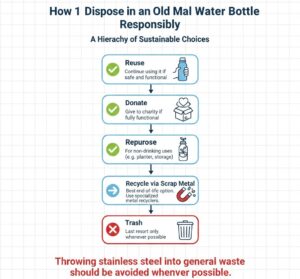
If a bottle is simply outdated or unused, consider the following hierarchy:
- Reuse – Continue using it if safe
- Donate – Only if fully functional
- Repurpose – For non-drinking uses
- Recycle via scrap metal – Best end-of-life option
- Trash – Last resort only
Throwing stainless steel into general waste should be avoided whenever possible.
Environmental Benefits of Recycling Stainless Steel Bottles
Recycling stainless steel has measurable environmental advantages:
- Energy savings: Recycling stainless steel uses significantly less energy than producing new steel from raw ore
- Reduced mining impact: Less demand for iron, chromium, and nickel extraction
- Lower emissions: Reduced greenhouse gas output across the supply chain
- Resource conservation: Keeps valuable materials in circulation
When done correctly, recycling one stainless steel bottle contributes to long-term sustainability far beyond the individual item.
Common Mistakes People Make When Recycling Stainless Steel Bottles
Even environmentally conscious consumers make errors that reduce recycling efficiency:
- Putting bottles directly into curbside bins
- Leaving plastic lids and silicone seals attached
- Recycling bottles with liquid inside
- Assuming “metal = recyclable everywhere”
Avoiding these mistakes increases the likelihood that your bottle is actually recycled.
Stainless Steel vs Plastic and Aluminum Bottles (Sustainability Context)
Compared to other bottle materials:
- Stainless steel lasts longer
- Has higher recycling value
- Can be recycled indefinitely
- Produces less waste over time
This makes proper disposal especially important.
Conclusion: Can You Recycle Stainless Steel Water Bottles?
Yes—stainless steel water bottles are highly recyclable, but only when disposed of correctly. Most should not go into curbside recycling bins. Instead, scrap metal recycling facilities provide the best environmental outcome.
If your bottle is broken, outdated, or no longer safe to use, recycling ensures its materials remain part of the production cycle rather than becoming waste. With proper preparation and disposal, stainless steel bottles continue to deliver environmental benefits long after their original use ends.