
How to Remove Smell from Stainless Steel Bottle: Easy Fixes for Odors, Metal Smell, and Lingering Residue
A stainless steel bottle is supposed to be one of the easiest drink containers to keep clean. It does not crack as easily as glass, it is more durable than plastic, and it generally resists odor better than many low-cost materials. So when a ανοξείδωτο ατσάλι bottle starts to smell bad, most people assume something is wrong with the bottle itself.
In many cases, that is not actually the problem.
The smell usually comes from trapped residue, moisture, old beverage oils, or poorly cleaned lid components rather than the stainless steel body. That is why some bottles smell fine after a quick rinse, while others keep a sour, stale, or metallic odor even after repeated washing.
If you have ever wondered:
- How do you get the smell out of stainless steel bottles?
- How to get smell out of a stainless steel container?
- How does stainless steel get rid of smells?
- How do you get the metal smell out of bottles?
this guide explains what causes the odor, how to remove it properly, and how to keep it from coming back.
Why Stainless Steel Bottles Sometimes Smell
Before trying different cleaning methods, it helps to understand why the smell appears in the first place.
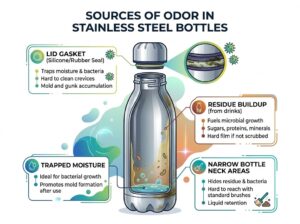
A stainless steel bottle can develop odor for several reasons:
- leftover coffee or tea oils
- protein shake residue
- milk or dairy-based drinks
- juice or sweetened beverages left inside too long
- moisture trapped inside after washing
- dirty lids, gaskets, or straws
- manufacturing residue in a brand-new bottle
The important thing to know is that stainless steel itself does not usually absorb odor the way some plastics do. The problem is more often caused by residue sitting on the surface or hidden in parts that are difficult to clean thoroughly.
This is especially common in bottles with:
- screw lids
- flip tops
- straw lids
- narrow bottle mouths
In other words, when a bottle smells bad, the odor is often coming from what is stuck inside it, not from the metal itself.
How Do You Get the Smell Out of Stainless Steel Bottles?
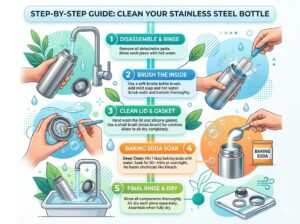
The best way to remove smell from a stainless steel bottle is to clean both the bottle body and the lid components thoroughly, then use a deodorizing soak if needed.
Step 1: Wash the Bottle with Warm Water and Dish Soap
Start with the most basic method first.
Fill the bottle with warm water and a small amount of mild dish soap. Use a bottle brush or soft sponge to clean:
- the bottom of the bottle
- the interior walls
- the neck area
- the threads near the opening
Do not just rinse and assume it is clean. Odor-causing residue often clings to the inside surface, especially after coffee, tea, flavored water, or sugary drinks.
Step 2: Remove and Clean the Lid Separately
This is the step many people skip, and it is one of the biggest reasons bottle odor keeps coming back.
Take apart the lid as much as possible. If there is a removable gasket, seal, or straw component, wash each piece separately. The gasket is often the real source of the smell because moisture and residue get trapped underneath it.
Wash the lid with warm soapy water and use a small brush or cotton swab to clean tight spaces.
Step 3: Use Baking Soda for Lingering Odors
If the bottle still smells after regular washing, baking soda is usually the safest and most effective next step.
Add 1 to 2 tablespoons of baking soda into the bottle. Fill it with warm water, close it loosely or leave it open, and let it sit for several hours or overnight.
After soaking, rinse thoroughly and smell the bottle again.
Baking soda works well for:
- mild sour smells
- stale water odor
- coffee smell
- general lingering bottle odor
Step 4: Use White Vinegar for Stronger Smells
If baking soda is not enough, white vinegar can help with stronger odors.
Pour a small amount of white vinegar into the bottle and dilute it with warm water. Let it sit for 30 minutes to several hours, depending on how strong the smell is. Then empty the bottle, wash it again with dish soap, and rinse thoroughly.
Vinegar is especially useful for:
- coffee residue
- tea odor
- sour or fermented smells
- old moisture smell
Step 5: Let Everything Dry Completely
Even after cleaning, a bottle can start smelling again if it is closed while still damp.
After washing, let the bottle air-dry completely. Leave the lid off and allow all parts, especially the gasket, to dry before sealing the bottle again.
This one habit prevents a large percentage of repeat odor problems.
How to Get Smell Out of a Stainless Steel Container
The same principles apply to a stainless steel container, thermos, or insulated food jar.
The key difference is usually shape.
A wide stainless steel container is often easier to clean than a narrow-mouth bottle because:
- you can reach inside more easily
- residue is less likely to get trapped near the shoulder
- airflow during drying is better
A narrow bottle, on the other hand, can hide odor in the lower corners, neck, and lid assembly.
To get smell out of a stainless steel container:
- Wash it with warm water and dish soap
- Clean the lid or closure separately
- Soak with baking soda or vinegar if odor remains
- Ξεπλύνετε καλά
- Let it dry completely before sealing
If the container had dairy, soup, protein drinks, or sweet liquids inside, do not rely on rinsing alone. Those residues cling much more than plain water.
How Does Stainless Steel Get Rid of Smells?
This question is often misunderstood.
Stainless steel does not actively remove odors on its own. It is not a deodorizing material. What makes it better than some alternatives is that it is relatively non-porous and easier to clean thoroughly.
That means:
- smells usually stay on the surface instead of soaking deeply into the material
- the container can often be restored with proper cleaning
- odors are less likely to become permanent if you clean the bottle correctly
So when people ask how stainless steel gets rid of smells, the most accurate answer is this:
Stainless steel gets rid of smells because it can be cleaned effectively, not because it automatically neutralizes odor by itself.
If a bottle still smells, it usually means:
- residue is still present
- the lid has not been cleaned properly
- the gasket is holding odor
- the bottle was sealed while wet
How Do You Get the Metal Smell Out of Bottles?
A “metal smell” can mean different things, and not all of them are true metal odor.
Sometimes what people call a metal smell is actually:
- new-product packaging smell
- manufacturing residue
- soap residue
- trapped old beverage smell
- moisture trapped in the lid
For a New Bottle
If the bottle is brand new and smells metallic or strange, wash it thoroughly before first use.
A good first cleaning routine is:
- Warm water and dish soap
- Full rinse
- Baking soda soak for a few hours
- Optional vinegar rinse if needed
- Final rinse and full air-dry
This usually removes most “new bottle” odor.
For an Older Bottle
If the bottle has been used for coffee, tea, protein drinks, or flavored beverages, what feels like a metal smell may actually be old residue plus trapped moisture.
In that case:
- clean the bottle body deeply
- remove and wash the gasket
- soak with baking soda or vinegar
- dry everything fully
When the Smell Might Be a Bigger Problem
If the bottle has:
- visible rust
- coating damage inside
- a persistent smell that never improves after deep cleaning
- damaged or deteriorating lid parts
then the issue may be beyond normal cleaning. At that point, it may be better to replace the lid or stop using the bottle if the interior condition is questionable.
Best Home Remedies for Removing Odor from Stainless Steel Bottles
If you want simple at-home methods, these are the most practical ones.
Baking Soda
Ιδανικό για:
- mild odor
- stale smell
- coffee smell
- general deodorizing
Why it works:
- gentle
- widely available
- safe for regular use
White Vinegar
Ιδανικό για:
- sour smell
- strong lingering residue
- tea or coffee buildup
Why it works:
- breaks down odor-causing residue
- helps freshen the bottle quickly
Lemon Water
Ιδανικό για:
- light freshening
- mild odor
- improving smell after washing
Why it works:
- can help lighten weak stale smells
- leaves a fresher scent than plain water
However, lemon is usually not enough for severe odor buildup.
Bottle Cleaning Tablets
Ιδανικό για:
- narrow-mouth bottles
- regular bottle users
- travel bottles and thermoses
Why they work:
- convenient
- designed to clean hard-to-reach spaces
- useful when brushing is difficult
What Not to Do When Removing Smell from a Stainless Steel Bottle
Good cleaning is not only about what to use. It is also about what to avoid.
Do Not Ignore the Lid
If you only clean the bottle body and skip the lid, the smell often returns immediately. Lid parts are one of the most common odor sources.
Do Not Seal the Bottle While It Is Wet
A clean bottle can still smell bad if you close it before it dries. Moisture trapped inside creates the perfect environment for stale odor.
Do Not Use Harsh Abrasive Scrubbers Aggressively
Metal scrubbers or overly rough tools can scratch surfaces and make the bottle harder to keep clean over time.
Do Not Assume One Quick Rinse Is Enough
After strong beverages like coffee, protein drinks, or juice, a quick rinse rarely removes all odor-causing residue.
Do Not Leave Smelly Drinks in the Bottle Too Long
If coffee, milk, or sweet drinks sit inside overnight or longer, odor removal becomes much harder.
How to Prevent Odors from Coming Back
Removing odor is useful, but preventing it is even better.
Wash the Bottle Soon After Use
The longer residue sits, the harder it is to remove. Try to wash the bottle the same day, especially after anything other than plain water.
Clean the Lid and Gasket Regularly
Do not wait until the smell becomes obvious. Regular cleaning of these parts prevents buildup.
Avoid Leaving Dairy or Sugary Drinks Inside for Long Periods
These drinks create stronger residue and are much more likely to leave sour smells behind.
Dry the Bottle and Lid Fully
This is one of the simplest and most effective prevention methods. Let the bottle air-dry before sealing it.
Store It Open When Possible
If you are not using the bottle every day, storing it with the lid off or loosely placed helps prevent trapped odor.
Why Stainless Steel Bottles Are Still Better for Odor Control Than Many Alternatives
Even though stainless steel bottles can smell if not cleaned properly, they are still one of the better options for long-term odor control.
Compared with some lower-cost plastic bottles, stainless steel is:
- easier to deodorize
- less likely to permanently retain beverage smell
- more durable under repeated washing
- better suited for coffee, tea, and daily reusable use
That is why most lingering smell issues in stainless steel bottles are usually fixable with the right cleaning method.
Final Answer: How to Remove Smell from a Stainless Steel Bottle
If you want the simplest answer, here it is:
To remove smell from a stainless steel bottle, wash the bottle and lid thoroughly with warm water and dish soap, clean the gasket separately, soak with baking soda or vinegar if needed, and let everything dry completely before sealing it again.
Most odors do not come from the stainless steel itself. They come from trapped residue, moisture, and neglected lid parts.
That is also why the solution is usually not complicated. In most cases, the smell can be removed with:
- proper washing
- deep cleaning of the lid
- baking soda or vinegar soak
- full air-drying
If the smell remains after repeated cleaning, check whether the lid, gasket, or bottle interior is damaged. A bottle that smells bad after deep cleaning may have a problem beyond simple residue.
FAQ
Why does my stainless steel bottle smell bad?
It usually smells because of trapped residue, moisture, or odor buildup in the lid, gasket, or narrow bottle areas rather than the stainless steel body itself.
Can baking soda remove odor from a stainless steel bottle?
Yes. Baking soda is one of the best home remedies for mild to moderate bottle odor and works well for stale smells and coffee residue.
Does vinegar damage stainless steel bottles?
In normal short soaking and proper rinsing, white vinegar is commonly used to help remove odor. It should not be left carelessly for excessive periods without rinsing.
How do I remove coffee smell from a metal bottle?
Wash the bottle with warm soapy water, clean the lid and gasket, then soak with baking soda or diluted white vinegar before rinsing and drying thoroughly.
Why does my bottle smell even after washing?
The smell may still be in the lid, gasket, straw parts, or trapped moisture. In many cases, the body is clean but the closure system is still holding the odor.
Is the smell coming from the bottle or the lid?
Very often, it is the lid. Silicone gaskets, threads, and hidden moisture in the cap are common odor sources in stainless steel bottles.